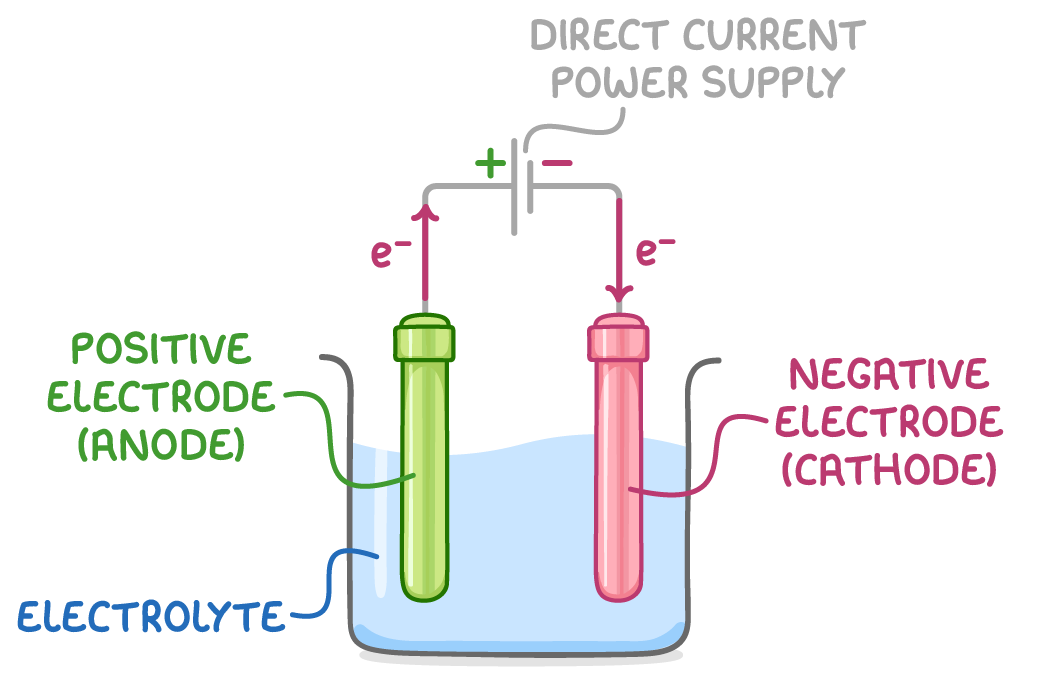
Electrolysis is the chemical decomposition of an electrolyte (a molten ionic compound or an aqueous solution of ions) by the passage of a direct electric current (DC).
Electrolysis Setup
Setup for electrolysis
Electrode Mechanisms and Electron Flow
An electrolytic cell uses an external power source to drive a non-spontaneous redox reaction. The process at each electrode is detailed below:
Cathode (Negative Electrode)
Electron Flow: Electrons flow from the negative terminal of the external power supply to this electrode, giving it a negative charge.
Ion Migration: Positive Ions (cations) in the electrolyte are attracted to this negative electrode.
Chemical Process: Cations gain electrons from the electrode surface:
Gaining electrons is reduction (OIL RIG).
Because reduction always occurs here, this electrode is defined as the cathode (Red Cat).
Anode (Positive Electrode)
Electron Flow: The positive terminal of the power supply withdraws electrons from this electrode, leaving it with a positive charge.
Ion Migration: Negative ions (anions) in the electrolyte are attracted to this positive electrode.
Chemical Process: Anions lose electrons to the electrode surface. These electrons travel back into the external circuit to complete the loop.
Losing electrons is oxidation (OIL RIG).
Because oxidation always occurs here, this electrode is defined as the anode (An Ox).
Tip
Anode and Cathode
Anode and Cathode are defined in terms of redox and not polarity or anion or cation.
The anode will always be the electrode where oxidation takes place.
The cathode will always be the electrode where reduction takes place.
Mnemonics to remember:
Red Cat (Reduction cathode)
An Ox (Anode oxidation)
Predicting Electrolysis Products
Factors Affecting Electrolysis Products
The products that will be formed at the anode and cathode depend on:
State of the electrolyte (Molten or Aqueous)
Position in Redox Series (Preferential discharge)
Concentration
1. Electrolysis of Molten Electrolyte
Electrolysis of a Molten Ionic Compound
A molten ionic compound contains only two types of ions:
1. Cation (positive)
Attracted to cathode (negative electrode).
Gain electrons and is reduced.
2. Anion (negative)
Attracted to anode (positive electrode).
Lose electrons and is oxidised.
Example: Electrolysis of Molten
Ions present:
Cation:
Anion:
At Anode (+ve)
ions are attracted to the anode.
They lose electrons and are oxidised to gas:
Observations: Bubbles of pale yellow chlorine gas are evolved.
At Cathode (-ve)
ions are attracted tot he anode.
They gain one electron and are reduced to metal:
Observations: Silvery liquid sodium metal forms.
2. Electrolysis of Aqueous Electrolytes
Preferential Discharge in Aqueous Electrolysis
Unlike molten electrolysis, aqueous electrolysis contains water molecules which partially dissociate to produce cations () and anions ():
Because there are competing ions at each electrode, we must apply the rules of preferential discharge to predict which species will actually react. Two factors determine this:
Standard Electrode Potential (): The ease of reduction/oxidation of a species.
Relative Concentration: High concentrations of certain ions can override standard electrode potential preferences.
1. Cation Discharge Order (At the Cathode)
Reduction at Cathode
The cathode is where reduction occurs.
Cations compete to gain electrons to be reduced.
The cation with the most positive (least negative) value has the greatest tendency to be reduced and is preferentially discharged.
Cation Discharge Series
Mnemonic
Ion
Standard Reduction Half-Equation
Value (V)
Ease of Discharge
Please
Most Difficult (Prefers to stay as ions)
Send
Charlies
Monkeys
And
Zebras
In
Lead
Holding
Reference Point (from water)
Cages
Most
Securely
Guarded
Easiest (Most readily reduced)
Important
Any metal above hydrogen in the reactivity series (negative ) will not be discharged in aqueous solution. Instead, ions from water are reduced to produce hydrogen gas ().
2. Anion Discharge Order (At the Anode)
Oxidation at Anode
The anode is where oxidation occurs.
Anions compete to lose electrons to be oxidised.
The anion with the more negative (less positive) value has the greatest tendency to be oxidised and is preferentially discharged.
📊 Anion Discharge Series
Mnemonic
Ion
Standard Reduction Half-Equation
Value (V)
Ease of Discharge
Send
Most Difficult (Water is oxidised instead)
Noodles
N/A (Nitrogen is already in maximum state)
Highly Positive
Chinese
Or
British
Instead
Easiest (Most readily oxidised)
Important
Because sulfate and nitrate are extremely stable (very high , they are never oxidised at the anode. Water is oxidised instead, producing oxygen gas ():
In aqueous solution, ions below are preferentially discharged.
3. The Concentration Exception
When performing electrolysis on an aqueous solution, the concentration of the electrolyte can change which ion is preferentially discharged at the electrodes. The classic example is the electrolysis of aqueous sodium chloride (NaCl).
A. Dilute Aqueous NaCl
In a dilute solution, we must compare the standard electrode potentials () of the competing reactions at the anode (oxidation):
Oxidation of Chloride:
Oxidation of Water:
Rule: The species with the less positive value is easier to oxidise.
Outcome: Because , water is preferentially oxidised. The product at the anode is Oxygen gas ().
B. Concentrated Aqueous NaCl (Brine)
When the concentration of is significantly increased, the rules change due to Le Chatelier’s Principle.
Take the chlorine half-equation:
Applying LCP: Increasing the concentration of ions adds stress to the product side of the reduction half-equation.
Equilibrium Shift: To counteract this change, the equilibrium shifts to the left (favouring the backward/oxidation reaction).
Effect on Electrode Potential: Because the backward reaction is favoured, the electrode potential () of the half-cell decreases (it becomes less positive than its standard ).
Outcome: The value for chlorine drops below that of water. becomes easier to oxidise than water.
Observation: is preferentially discharged, and the product at the anode is Chlorine gas ().
TL;DR: Concentration Effect on NaCl Electrolysis
Dilute NaCl: Water oxidised produced.
Conc NaCl: High shifts left decreases oxidised produced.