6. Determining Avogadro’s Constant (
Apparatus:
- Pure copper anode and cathode.
- Aqueous Copper(II) Sulfate electrolyte.
- DC power supply, ammeter, variable resistor (to keep current constant).
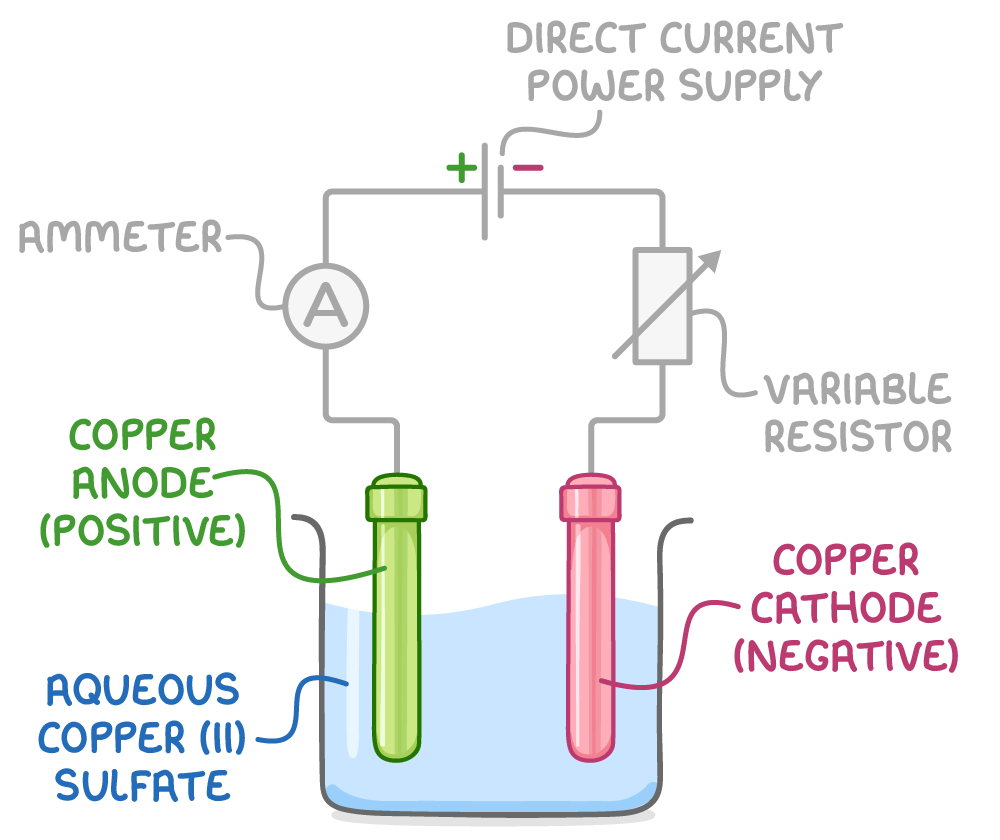
Method:
- Weigh the pure copper anode before the experiment.
- Pass a known constant current (
) for a known time ( in seconds). - Remove the anode, wash with distilled water, dry with propanone (evaporates quickly), and reweigh.
- Calculate mass lost by anode
calculate moles of Cu dissolved ( ).
Calculation:
- Half equation:
(1 mol Cu releases 2 mol ). - Moles of electrons passed =
. - Total charge
. - Charge of 1 mole of electrons (Faraday,
) = - Avogadro’s Constant
Why use the Anode?
Past papers frequently ask why we measure the mass loss of the anode rather than the mass gain of the cathode. Answer: Copper deposited at the cathode does not always stick properly and can flake off, leading to inaccurate (lower) mass readings. The mass lost from the anode is a much more reliable metric.