There are three types of half-cells that can be connected to a standard hydrogen electrode:
Metal / Metal ion half-cell
Non-Metal / Non-Metal ion half-cell
Ion / Ion half-cell (the ions are in different oxidation states)
Representing Half-Cells
When writing shorthand representations for individual half-cells (redox couples), the IUPAC convention dictates that the species with the higher oxidation state (the oxidized form) is always written on the left:
Why? This order mirrors the direction of standard reduction half-equations (), which is how they are listed in data tables.
Examples:
(Oxidation states: )
(Oxidation states: )
(Oxidation states: )
1. Metal / Metal Ion
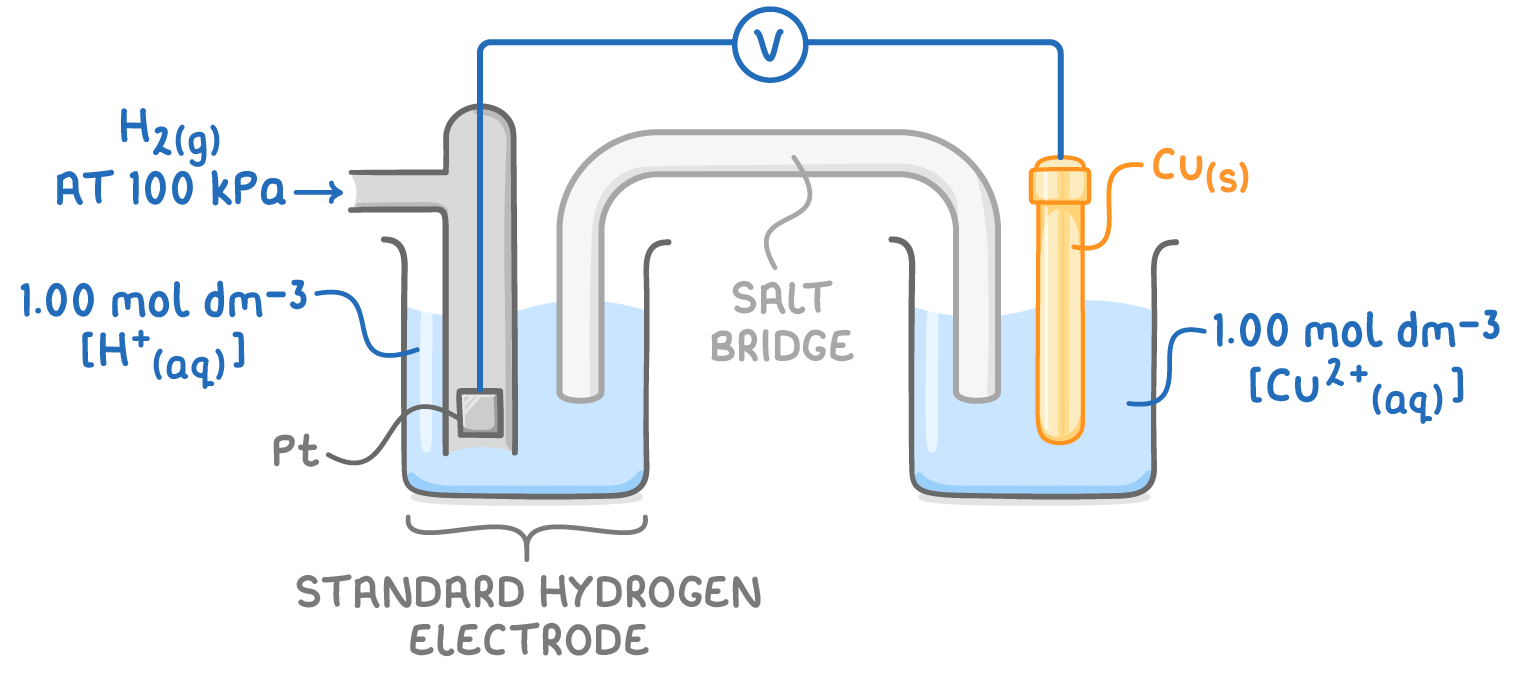
Metal / Metal Ion Half-Cell
The metal itself acts as the electrode.
It is dipped in of its ions.
What happens to the metal electrode?
The behavior of a metal electrode depends on whether it acts as the cathode or the anode in the electrochemical cell:
If the electrode is the Cathode (Reduction):
Aqueous metal ions are reduced to solid metal:
Result: The concentration of aqueous ions decreases, while the mass of the metal electrode increases.
If the electrode is the Anode (Oxidation):
The solid metal electrode is oxidized to aqueous ions:
Result: The concentration of aqueous ions increases, while the mass of the metal electrode decreases.
Example: Half-Cell
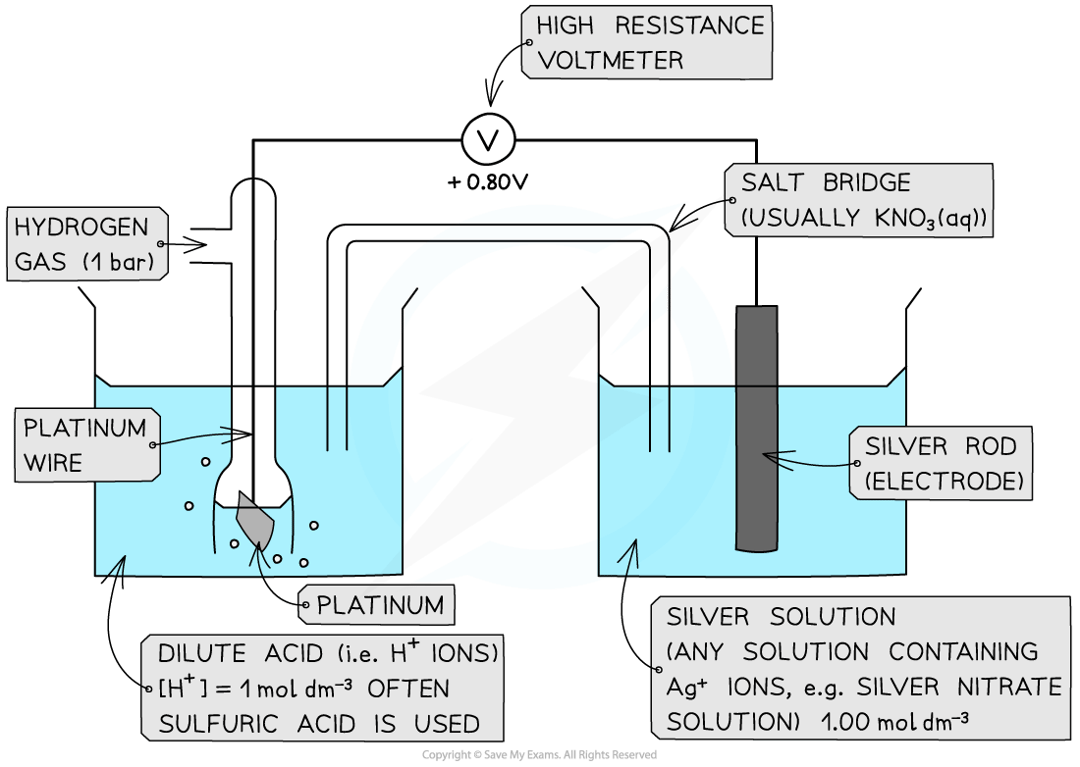
Electrode: Silver metal ()
Solution:
When this half-cell is connected to a standard hydrogen electrode (SHE), the two half-equations are:
The potential difference between the two half-cells is:
Therefore, the voltmeter reading will be .
Under standard conditions, a metal / metal ion half-cell is connected to the standard hydrogen electrode to measure the cell potential.
Because the silver half-cell has the more positive value, it acts as the cathode (reduction occurs). Over time, the concentration of will decrease, and the mass of the silver electrode will increase.
2. Non-Metal / Non-Metal Ion
Non-Metal / Non-Metal Ion Half-Cell
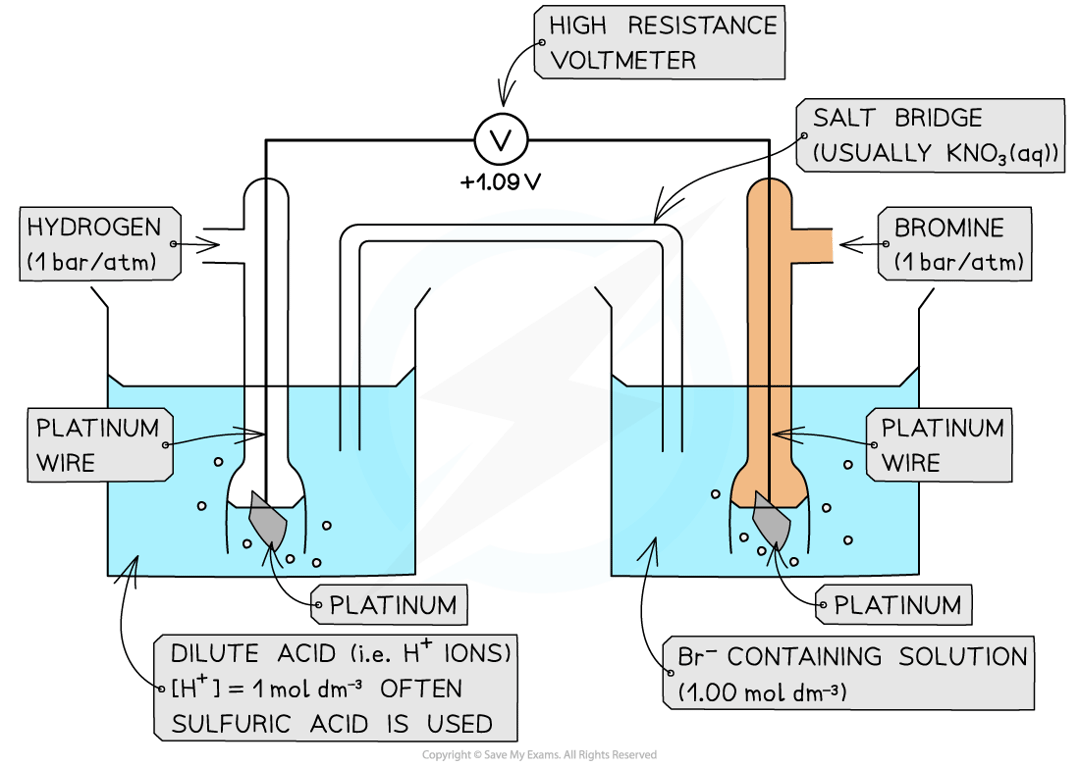
Platinum is used as electrode to make electrical contact with the solution.
Gas is bubbled at 1 atm into a solution of the non-metal ions.
Half-Cell
Electrode: Platinum
Solution:
When this half-cell is connected to a standard hydrogen electrode (SHE), the two half-equations are:
The potential difference between the two half-cells is:
Therefore, the voltmeter reading will be .
Under standard conditions, a non-metal / non-metal ion half-cell is connected to the standard hydrogen electrode to measure the cell potential
3. Ion / Ion (Different Oxidation States)
Ion / Ion Half-Cell
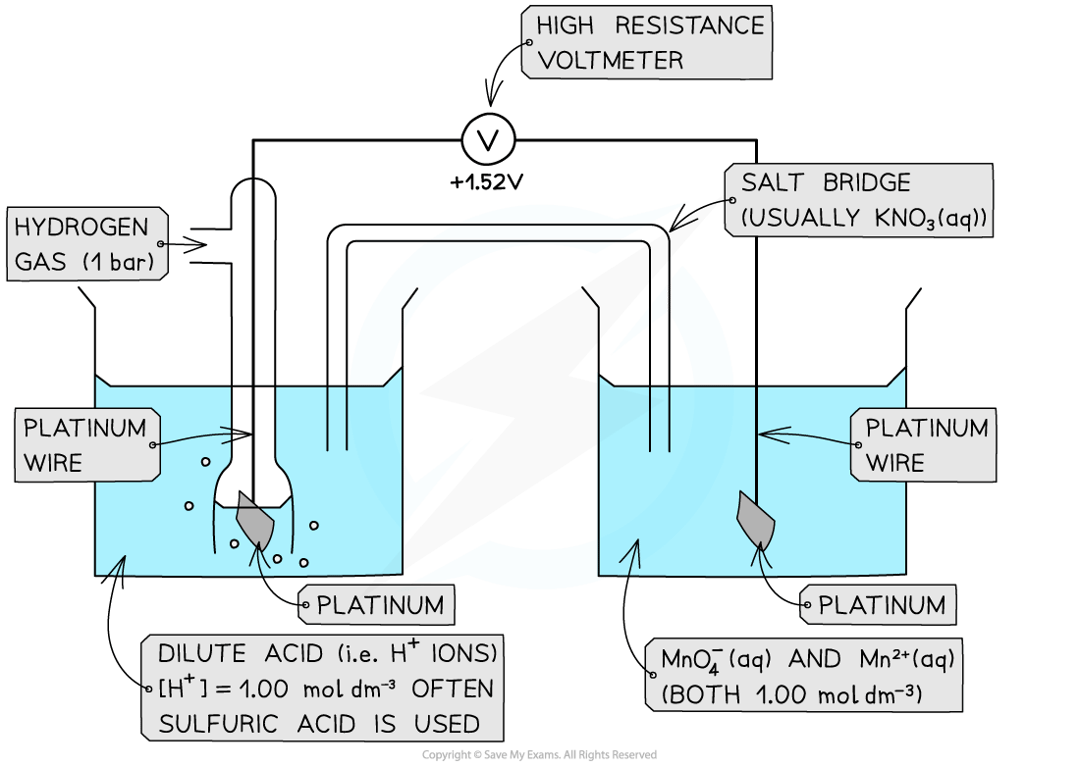
Platinum is used as electrode to make electrical contact with the solution.
Both ions must be present in the solution at . i.e. a mixture containing of each ion.
Half-Cell
Electrode: Platinum
Solution: +
contains with oxidation number of
contains with oxidation number of
When this half-cell is connected to a standard hydrogen electrode (SHE), the two half-equations are:
The potential difference between the two half-cells is:
Therefore, the voltmeter reading will be .
Under standard conditions, an ion / ion half-cell is connected to the standard hydrogen electrode to measure the cell potential
Salt Bridge
Salt Bridge
When a half-cell is connected to a standard hydrogen electrode, or when two half-cells are connected, a salt bridge is required:
A salt bridge complete the circuit by allowing mobile ions to flow between the two half-cells.
A salt bridge is typically a strip of filter paper soaked in a saturated solution of potassium nitrate ().
A salt bridge completing the circuit between two half-cells.
Why is Potassium Nitrate ( ) used?
1. Universal Solubility of Nitrates
All nitrates are soluble, this ensures that no precipitate forms which would alter ion concentrations and shift the equilibrium.
2. Similar Ionic Mobility
and have almost identical sizes when hydrated and move at the exact same speed.
If one ion moved faster than the other, positive or negative charge would build up at the ends of the salt bridge, creating a disruptive voltage (liquid junction potential) which would interfere with the voltmeter reading.