The voltage of a half-cell compared to a standard hydrogen electrode
Measured under standard conditions of , pressure, and ion concentration
Standard Cell Potential ( )
The potential difference between two half-cells
Measured under standard conditions of , pressure, and ion concentration
Standard Conditions
Standard Electrode Potential () and Standard Cell Potential () are always measured under standard conditions.
Standard Conditions:
Temperature of
Pressure of
Ion concentration of
Standard Hydrogen Electrode (SHE)
Standard Hydrogen Electrode (SHE)
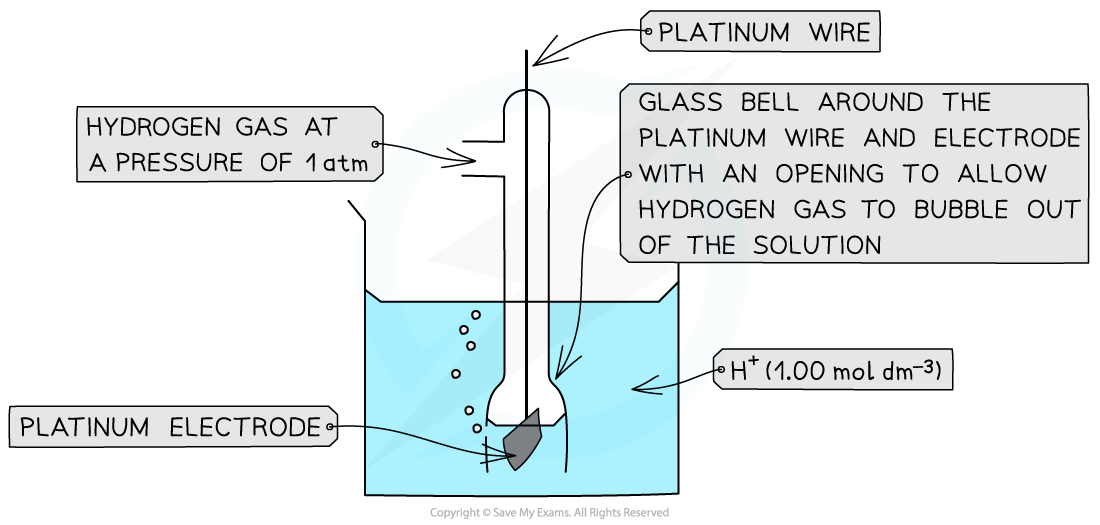
The standard hydrogen electrode is a half-cell used as a reference electrode.
It consists of hydrogen gas () at in equilibrium with ions of concentration :
It is arbitrarily assigned a Standard Electrode Potential () of .
Standard Hydrogen Electrode
Why is a Platinum ( ) electrode used?
Platinum is inert, conducts electricity, and provides a surface area for the redox equilibrium to occur without taking part in the reaction itself.
Use of a Standard Hydrogen Electrode
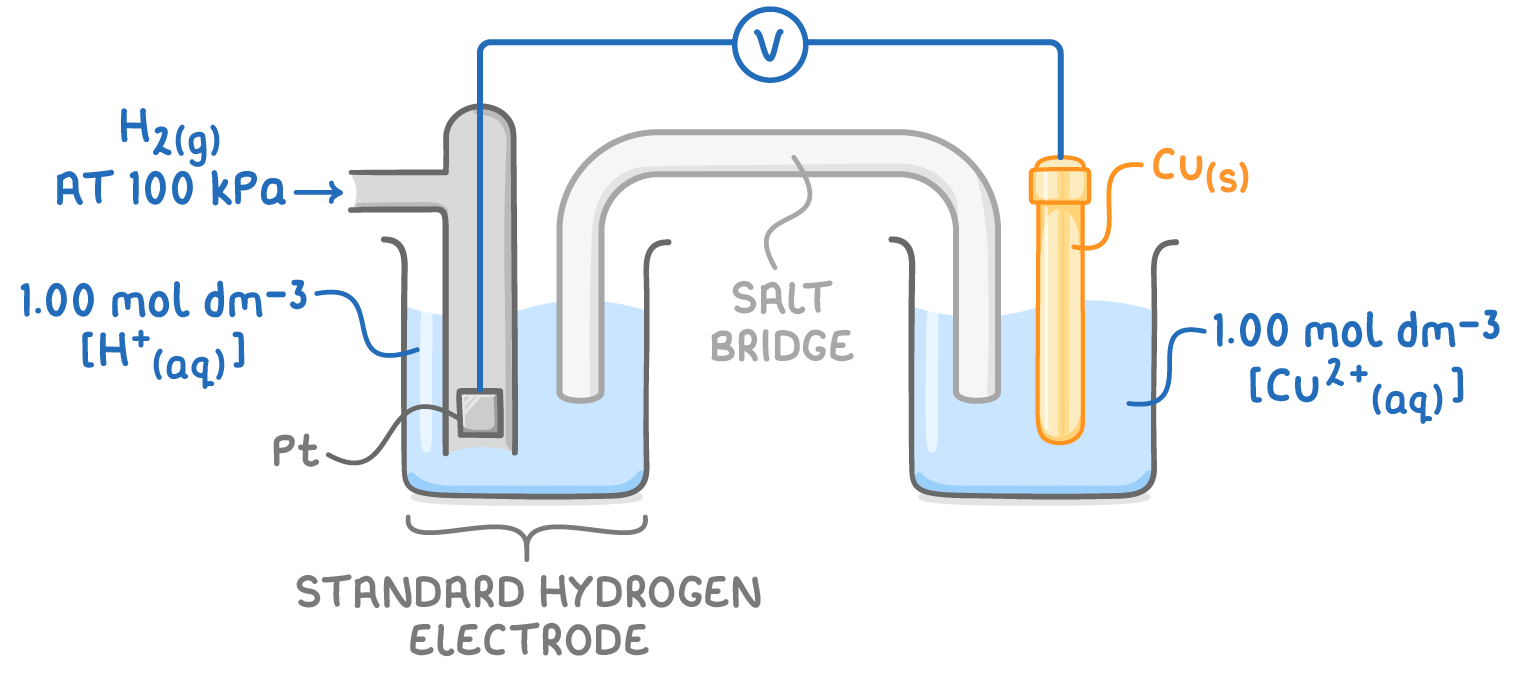
Because we cannot directly measure the potential of a single half-cell, the Standard Hydrogen Electrode is connected to it to be used as a reference.
Since the Standard Hydrogen Electrode has a of , a voltmeter connected to the SHE and the half-cell to be measured will simply give the of the half-cell.
The standard electrode potential of a half-cell can be determined by connecting it to a standard hydrogen electrode.