Here is a comprehensive, Obsidian-optimised master note file for 9701 A Level Chemistry: Chapter 24 - Electrochemistry.
It has been synthesized using the provided SaveMyExams notes, Collins textbook insights, exact syllabus requirements, and crucial examiner commentary based on the provided mark schemes.
🔋 Chapter 24: Electrochemistry
Chapter Overview
Electrochemistry links chemical energy to electrical energy. This topic is split into two main sections:
- Electrochemical Cells (Galvanic/Voltaic): Chemical reactions produce an electrical voltage (spontaneous).
- Electrolytic Cells: Electrical voltage drives a chemical reaction (non-spontaneous).
1. Standard Electrode Potentials (
Definitions (Strict CIE Mark Scheme Phrasing)
To secure the marks in the exam, your definitions must be perfectly aligned with the syllabus.
Standard Electrode Potential (
) The potential difference (voltage) of a half-cell compared to, or connected to, a standard hydrogen electrode (SHE) under standard conditions.
Standard Cell Potential (
) The potential difference between two half-cells/electrodes in an electrochemical cell measured under standard conditions.
Standard Conditions:
- Temperature: 298 K (
) - Pressure: 101 kPa (1 atm) for any gases
- Concentration:
for all aqueous ions. - Examiner Trap: If using
for ions, the concentration of the acid must be because it is diprotic ( ).
- Examiner Trap: If using
The Standard Hydrogen Electrode (SHE)
Because you cannot measure the absolute potential of a single half-cell, we measure everything against the SHE, which is arbitrarily assigned a value of
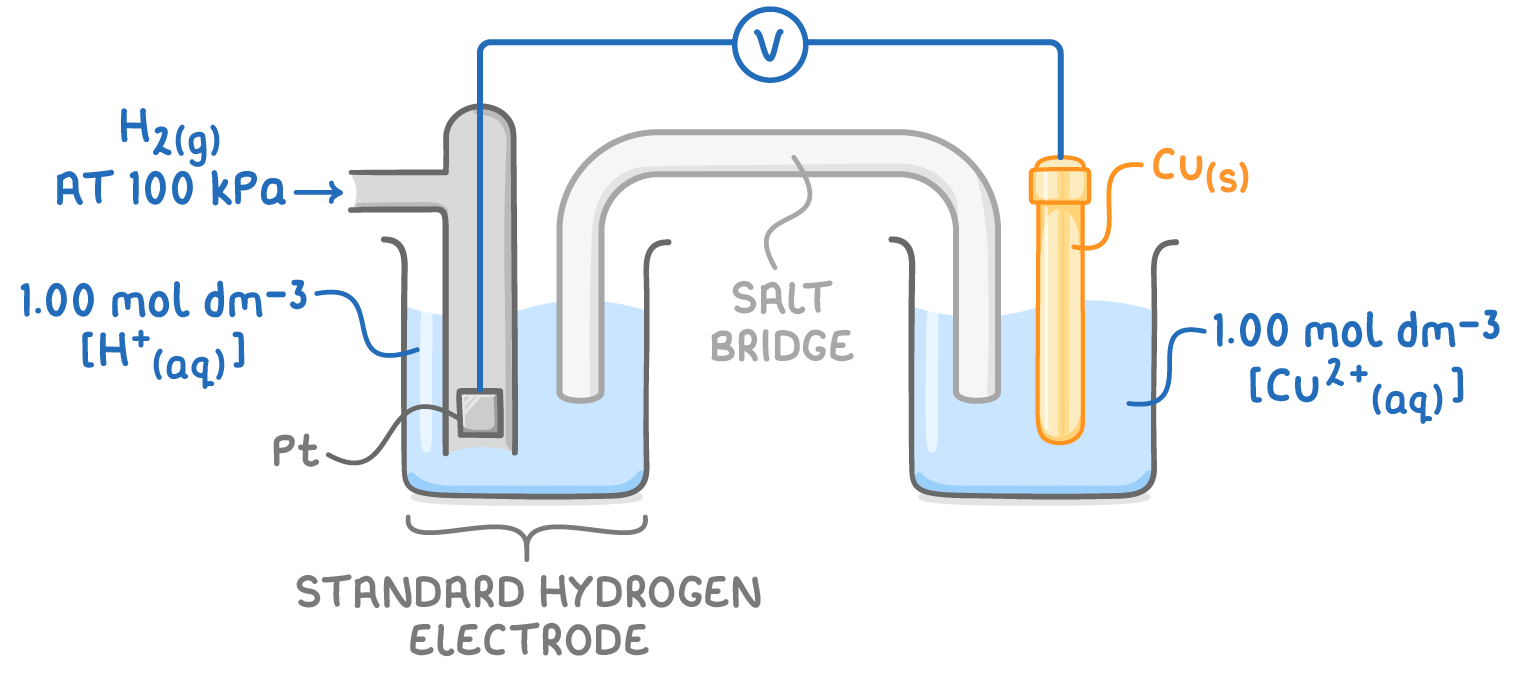
- Electrode: Platinised Platinum (Pt). Why Pt? It is inert, conducts electricity, and provides a surface area for the redox equilibrium to occur without taking part in the reaction itself.
- Reaction:
2. Types of Half-Cells and Measuring
When drawing or describing apparatus to measure
The Salt Bridge
Usually filter paper soaked in saturated Potassium Nitrate (
) or Potassium Chloride ( ).
- Purpose: Completes the circuit by allowing mobile ions to flow, maintaining ionic balance.
- Why
? Nitrates are universally soluble, ensuring no precipitates form which would alter ion concentrations and shift the equilibrium.
Type 1: Metal / Metal Ion
E.g.,
- The metal itself acts as the electrode.
- Dipped in a
solution of its ions.
Type 2: Non-Metal / Non-Metal Ion
E.g.,
- Requires an inert Platinum (Pt) electrode.
- Gas is bubbled at 1 atm into a
solution of the ions.
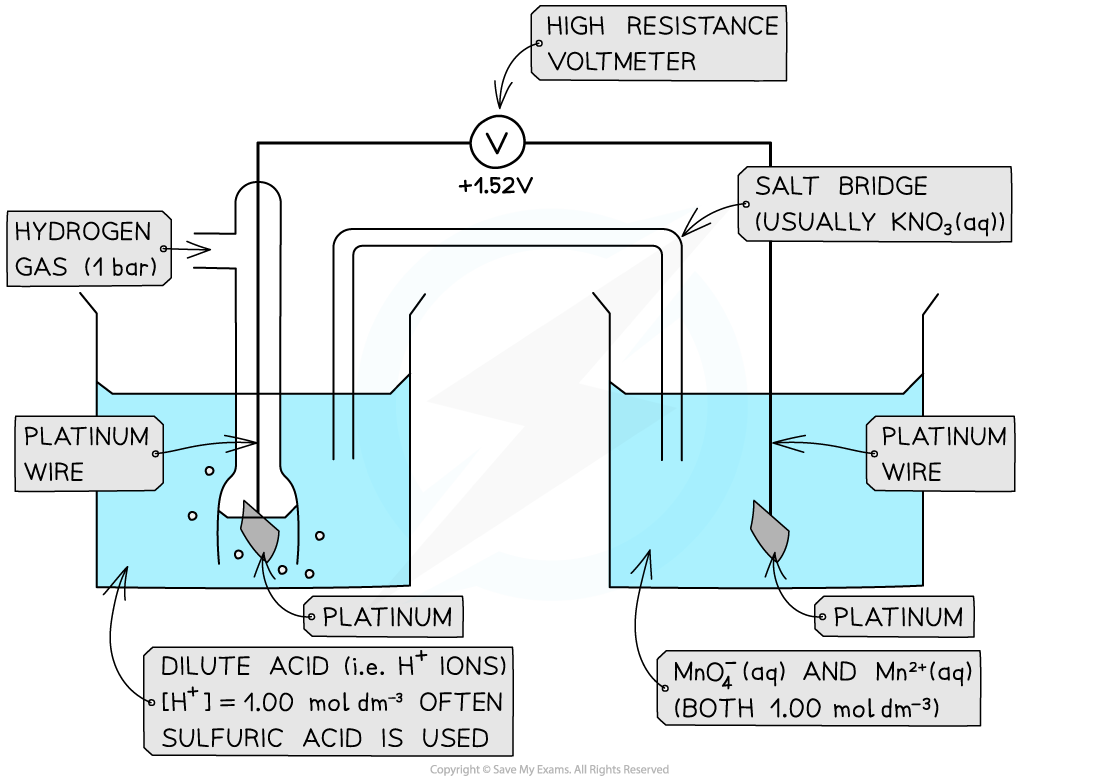
Type 3: Ion / Ion (Different Oxidation States)
E.g.,
- Requires an inert Platinum (Pt) electrode.
- Crucial: Both ions must be present in the solution at
. (e.g., A mixture containing AND ).
3. Cell Potentials, Polarity, and Feasibility
Calculating
When two half-cells are connected:
- Most positive
= Reduction (Cathode) = Positive Pole (Gains electrons) - Most negative
= Oxidation (Anode) = Negative Pole (Loses electrons)
Direction of Electron Flow
Consider
( ) and ( ).
is more positive: Reduction occurs here. Positive Pole. is more negative: Oxidation occurs here. Negative Pole. - Electron Flow: Through the external wires from Negative (
) to Positive ( ).
Feasibility of a Reaction
A reaction is feasible (spontaneous) if the calculated
Gibbs Free Energy (
There is a direct mathematical link between the standard cell potential and the standard Gibbs free energy:
= Standard Gibbs free energy change (Joules, J mol — Divide by 1000 for kJ!) = Number of moles of electrons transferred in the balanced overall equation. = Faraday constant ( ) = Standard cell potential (V)
Classic Exam Error
The equation gives
in Joules. CIE questions almost always ask for the answer in kJ mol . Do not forget to divide your final answer by 1000! Also, ensure you attach the correct sign: if is positive, MUST be negative.
4. Non-Standard Conditions: The Nernst Equation
If concentrations are NOT
We calculate the exact new potential using the Nernst Equation:
= Electrode potential under non-standard conditions = Standard electrode potential (from Data Booklet) = Number of electrons transferred in the half-equation = Concentration of the species on the side of the half-equation with the electrons (usually the left). = Concentration of the species on the side without electrons.
Nernst Equation Rules
- Solids and liquids are ignored (their concentration is given a value of 1).
- If a species has a molar coefficient in the half-equation (e.g.,
), its concentration must be raised to that power (e.g., ).
Qualitative Nernst (Le Chatelier):
Given
- If we add water (dilute the solution),
decreases. - Equilibrium shifts to the left to oppose the change.
- The species gets less easily reduced, so
becomes less positive (e.g., ).
5. Electrolysis
Electrolysis uses direct current (DC) to break down an electrolyte.
Predicting Products
When an aqueous solution is electrolysed, water provides
At the Cathode (Negative Electrode) - Reduction:
- Competitors: Metal cation (e.g.,
) vs . - Rule: The species with the most positive
is discharged. - Result: Unreactive metals (
) are discharged. Reactive metals ( ) stay in solution, and gas is discharged instead.
At the Anode (Positive Electrode) - Oxidation:
- Competitors: Anion (e.g.,
) vs . - Rule: The species with the most negative
is most easily oxidised. - THE CONCENTRATION CATCH:
( ) ( ) - Normally,
should discharge to give (it is much more negative). However, if the halide is concentrated, the Nernst shift makes the Halide discharge instead! - Dilute NaCl:
produced. - Concentrated NaCl:
produced.
Faraday’s Laws & Calculations
- Quantity of Charge (
): = Charge in Coulombs (C) = Current in Amperes (A) = Time in seconds (s)
- Faraday Constant (
): The charge of 1 mole of electrons. - Avogadro Constant (
): (where is the charge of a single electron, ).
Calculation Steps for Mass/Volume Liberated:
- Calculate
. - Calculate moles of electrons:
. - Use the half-equation to find the molar ratio of electrons to product.
- Calculate moles of product
convert to mass ( ) or volume ( ).
6. Determining Avogadro’s Constant (
This is a specific syllabus requirement and a classic Paper 4/Paper 5 question.
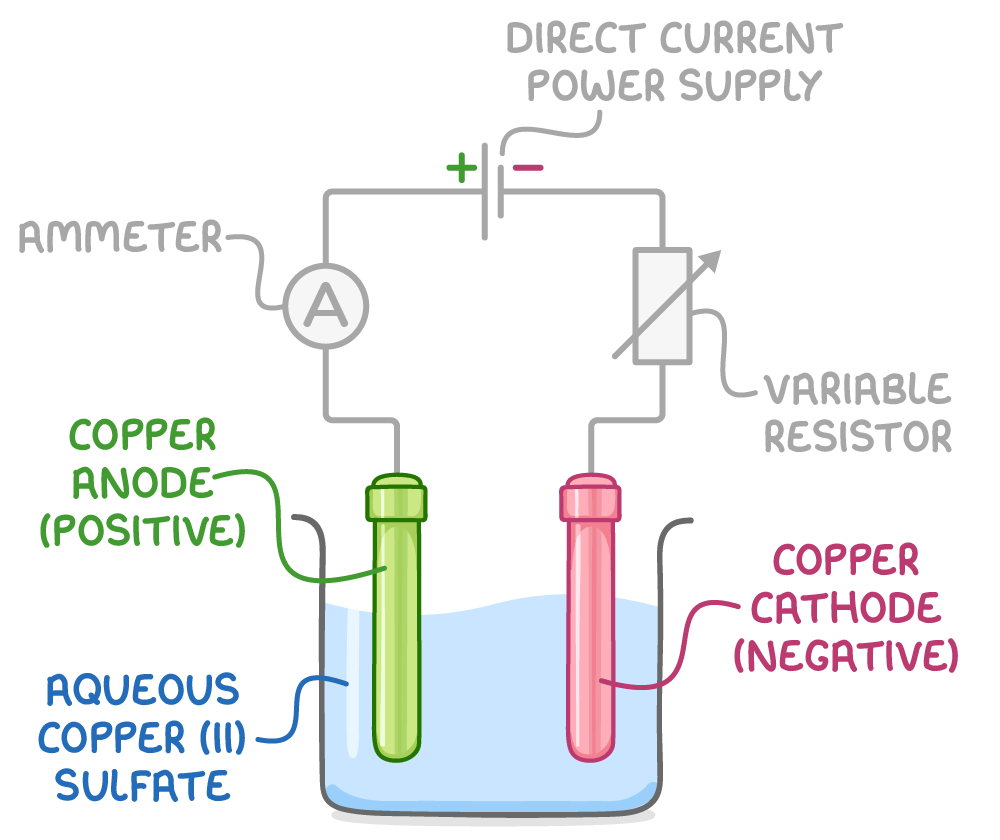
Apparatus:
- Pure copper anode and cathode.
- Aqueous Copper(II) Sulfate electrolyte.
- DC power supply, ammeter, variable resistor (to keep current constant).
Method:
- Weigh the pure copper anode before the experiment.
- Pass a known constant current (
) for a known time ( in seconds). - Remove the anode, wash with distilled water, dry with propanone (evaporates quickly), and reweigh.
- Calculate mass lost by anode
calculate moles of Cu dissolved ( ).
Calculation:
- Half equation:
(1 mol Cu releases 2 mol ). - Moles of electrons passed =
. - Total charge
. - Charge of 1 mole of electrons (Faraday,
) = - Avogadro’s Constant
Why use the Anode?
Past papers frequently ask why we measure the mass loss of the anode rather than the mass gain of the cathode. Answer: Copper deposited at the cathode does not always stick properly and can flake off, leading to inaccurate (lower) mass readings. The mass lost from the anode is a much more reliable metric.
7. 🕵️♂️ The Examiner’s Vault: Past Paper Tropes & Traps
Based on an analysis of the 2009–2022 Paper 4 question bank, pay close attention to these highly repetitive concepts:
Trope 1: Fuel Cells (e.g., Hydrogen-Oxygen)
- Question: “Suggest why the voltage of the fuel cell remains constant.”
- Mark Scheme Answer: The reagents (fuel and oxygen) are being continuously supplied / fed in, and concentration of the electrolyte remains constant.
Trope 2: Disproportionation
- Question context: They will give you a species like
or and ask you to prove it disproportionates using values. - Action: Find the two half-equations where the species acts as an oxidising agent (gets reduced) and a reducing agent (gets oxidised). Calculate
. If positive, it disproportionates.
Trope 3: Drawing Cells with Specificity
- If asked to draw a cell to measure the
of , you will lose marks if you do not explicitly label the solution as containing of AND of . - Must include: Salt bridge, Voltmeter, Pt electrode, Standard Hydrogen Electrode (with
and ).
Trope 4: The Nernst Equation Trap
- Question: Calculate
for the electrode when . - Mistake: Students try to put
into the Nernst equation. - Mark Scheme Answer: Solids are omitted!
(Because the solid Ag acts as a 1).
Trope 5: “State the relationship between F, L and e”
- Mark Scheme Answer:
(or ). 1 mark. Free points, do not forget this simple formula.
Trope 6: Justifying Relative Reactivity
- Question: “Use the Data Booklet to explain why silver remains as a metal but nickel dissolves at the anode during purification.”
- Action: Quote the
values! - Mark Scheme phrasing: ”
for is more positive than for / or , so Ag is less easily oxidised / prefers to remain reduced as a solid.”