7.1.1 Reversible Reactions and Dynamic Equilibrium
3 min read
Reversible Reactions
What is a reversible reaction?
A reaction that proceeds in both the forward and backward direction
Where the products can react to form the original reactants.
Dynamic Equilibrium
Success
9701_s24_qp_22 - Q3.a
Rate of forward and backward reactions are equal
The concentration of products and reactants remain constant
Common Misconception: Equal vs Constant
Do not confuse Rate with Concentration!
Rates: At equilibrium, the rate of forward and backward reactions are EQUAL.
Concentrations: At equilibrium, concentrations are CONSTANT, but they are rarely equal to each other.
Condition for reaching dynamic equilibrium
Condition: Closed System
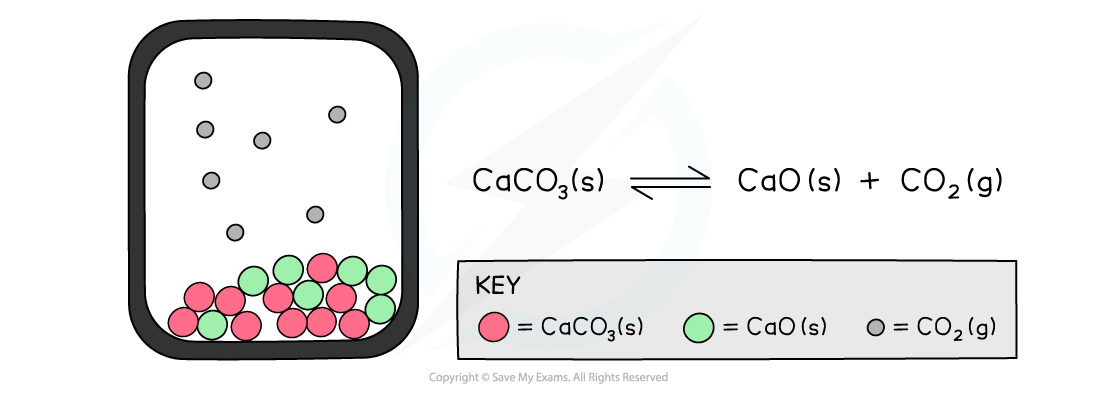
Dynamic equilibrium can only be established in a closed system (where energy may be exchanged, but matter cannot).
Why is it necessary?
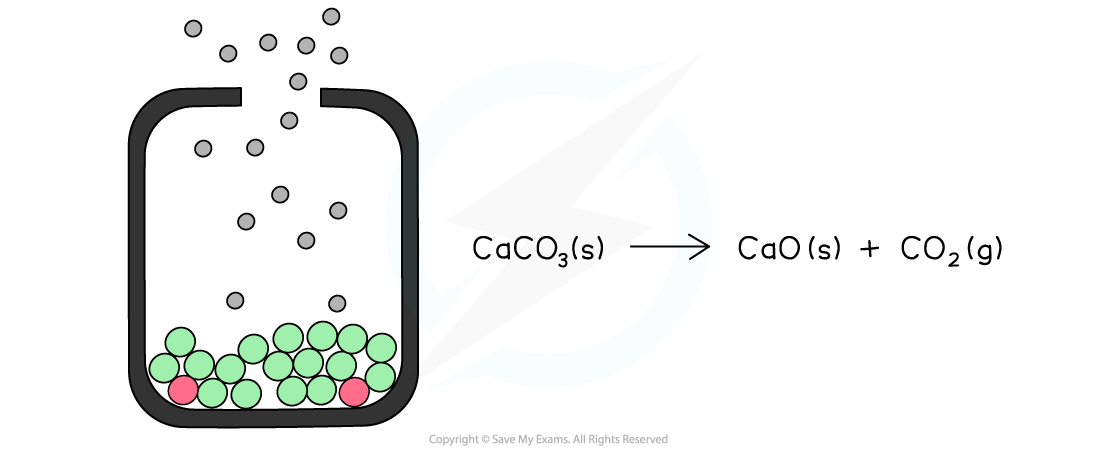
Containment: If the system is open, products (especially gases) may escape into the surroundings.
Collisions: Escaped products are unavailable to react with each other to reform reactants.
Consequence: The rate of the backward reaction would fall to zero, causing the reaction to go to completion rather than reaching equilibrium.
Example: The decomposition of calcium carbonate into carbon dioxide
In a closed system where no carbon dioxide gas can escape, an equilibrium forms as the carbon dioxide turns back into calcium carbonate which turns into carbon dioxide and so on.
If the system were open, the carbon dioxide would continually escape and the calcium carbonate would keep on decomposing until all of it was gone.
Concentration of Reactants and Products
How concentration of reactants and products vary with time
Imagine you have the following reaction:
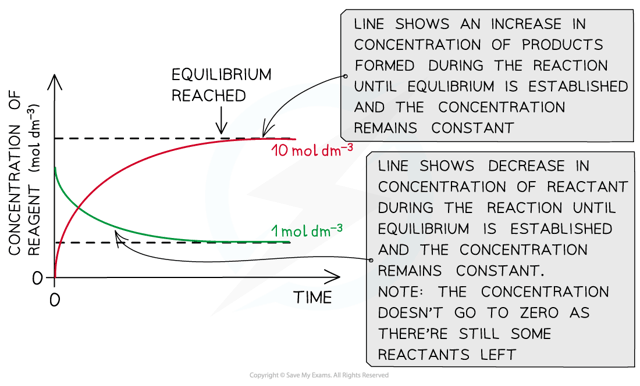
A. Approaching Equilibrium from the Forward Direction
Action: You place pure substance into the reaction vessel.
Result: turns into . ()
Endgame: Eventually, the rate of equals the rate of .
Green Line: Reactants, Red Line: Products
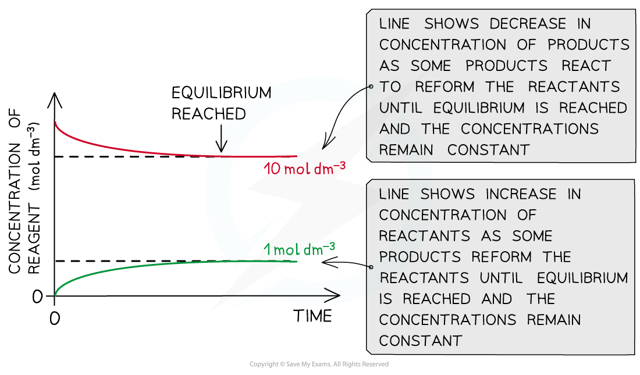
B. Approaching Equilibrium from the Backward Direction
Action: You place pure substance into the reaction vessel.
Result: turns into . ()
Endgame: Eventually, the rate of equals the rate of .
Green Line: Reactants, Red Line: Products
Why is dynamic equilibrium reached? (extra)
Extra Info: Why does dynamic equilibrium happen?
A. Why do rates of forward and backward reactions become equal?
At the start ():
You have a high concentration of reactants and zero products.
Because the concentration of reactants is high, the frequency of effective collisions between reactant molecules is at its maximum. Therefore rate of forward reaction is at its highest.
Because there are no products yet, the rate of reverse reaction is zero.
As the reaction proceeds:
Rate of forward reaction decreases: Reactants are consumed, so their concentration falls. This reduces the frequency of effective collisions between reactant molecules, causing the forward rate to gradually slow down.
Rate of backward reaction increases: Product molecules are formed, increasing their concentration. This increases the frequency of effective collisions between product molecules, causing the backward rate to gradually speed up.
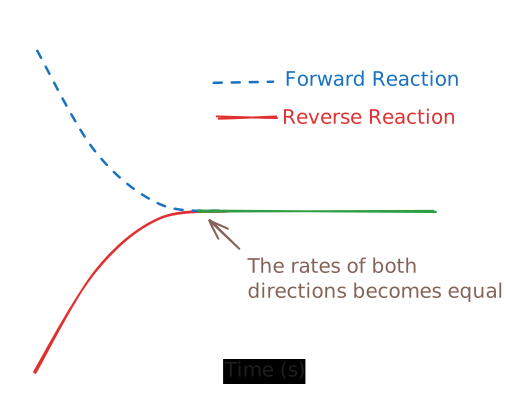
The Intersection:
Since the forward rate is dropping and the backward rate is rising, there must mathematically be a point where they meet. At this precise moment, the speed at which reactants turn into products equals the speed at which products turn back into reactants.
Forward rate gradually decreases while backward rate gradually increases, eventually they meet and equalise
B. Why do the concentrations remain constant?
Once the rates are equal, the system enters a state of dynamic balance.
Imagine a bucket with a hole in it, being filled by a tap:
The water entering from the tap is the forward reaction.
The water leaking out from the hole is the backward reaction.
If the amount of water entering per second exactly equals the amount of water leaking out per second, the water level (concentration) in the bucket will not change, even though water is constantly flowing through it.
In chemical terms:
At equilibrium, for every molecule of reactant consumed by the forward reaction, exactly one molecule of reactant is regenerated back by the backward reaction.
Therefore, the net change in concentration is zero.
For every reactant molecule that becomes a product, a product molecule becomes a reactant