The position of equilibrium is a qualitative term describing the relative proportions of reactants and products present in the mixture once dynamic equilibrium is established
Position
Composition
Implication for
Lies to the LEFT
Mixture contains mainly Reactants
Small ()
Lies to the RIGHT
Mixture contains mainly Products
Large ()
What is Le Chatelier's Principle
Syllabus
If a change is made to a system at dynamic equilibrium the position of equilibrium shifts
To minimise this change.
Effect of Changing Conditions on a System at Equilibrium
1. Concentration
Consider the following reaction:
Case 1: Concentration of a reactant is increased
Scenario: More or is added to the system.
Disturbance: The concentration of reactants is too high.
System Response: To minimise the effect of more reactants, the system acts to consume the added reactants.
Shift: The position of equilibrium shifts to the RIGHT.
Mechanism:
Since there are more reactant molecules per unit volume, frequency of effective collisions increases.
The rate of forward reaction increases relative to the backward reaction.
Outcome: The yield of products increases.
Case 2: Concentration of a reactant is decreased
Scenario: Some or is removed from the system.
Disturbance: The concentration of reactants is too low.
System Response: To minimise the effect of less reactants, the system acts to replace the missing reactants.
Shift: The position of equilibrium shifts to the LEFT.
Mechanism:
Since there are less reactant molecules per unit volume, frequency of effective collisions decreases.
The rate of forward reaction decreases relative to the backward reaction.
Outcome: Products are consumed to reform reactants.
Case 3: Concentration of a product is increased
Scenario: More or is added to the system.
Disturbance: The concentration of products is too high.
System Response: To minimise the effect of more products, the system acts to remove the excess product.
Shift: The position of equilibrium shifts to the LEFT.
Mechanism:
Since there are more product molecules per unit volume, frequency of effective collisions increases.
The rate of backward reaction increases relative to the forward reaction.
Outcome: Concentration of reactants increases.
Case 4: Concentration of a product is decreased
Scenario: or is removed from the system.
Disturbance: The concentration of products is too low.
System Response: To minimise the effect of less products, the system acts to replace the removed product.
Shift: The position of equilibrium shifts to the RIGHT.
Mechanism:
Since there are less product molecules per unit volume, frequency of effective collisions increases.
The rate of backward reaction decreases compared to the forward reaction.
Outcome: The yield of products increases.
2. Temperature
Consider the following equation:
Case 1: Temperature Increased
If you heat the reaction mixture, the system acts to lower the temperature by absorbing the excess thermal energy.
System Response: The system favours the endothermic reaction (the direction that absorbs heat).
Shift: The position of equilibrium shifts in the endothermic direction (in this case, the forward direction).
Outcome:
If the forward reaction is endothermic, the yield of products increases.
If the forward reaction is exothermic, the yield of products decrease.
Case 2: Temperature Decreased
If you cool the reaction mixture, the system acts to raise the temperature by releasing thermal energy.
System Response: The system favours the exothermic reaction (the direction that releases heat).
Shift: The position of equilibrium shifts in the exothermic direction (in this case, the backward direction).
Outcome:
If the forward reaction is exothermic, the yield of products increases.
If the forward reaction is endothermic, the yield of products decreases.
Extra Info: How does the system know which direction to choose ?
A. The Arrhenius Equation
The Arrhenius Equation, which is derived from Maxwell-Boltzmann Statistics, describes how the rate of an equation varies with temperature and activation energy:
Where:
: The Rate Constant (how fast the reaction is).
: The Pre-exponential Factor (represents the frequency of collisions and the correct orientation).
: The Activation Energy (in ).
: The Gas Constant ().
: Temperature (in Kelvin).
The term calculates the fraction of total collisions that have energy .
As gets larger, the exponent becomes less negative, so the value of the term increases (more successful collisions).
As gets larger, the exponent becomes more negative, so the value drops (fewer successful collisions).
B. Applying the Arrhenius Equation
Consider the following reversible reaction:
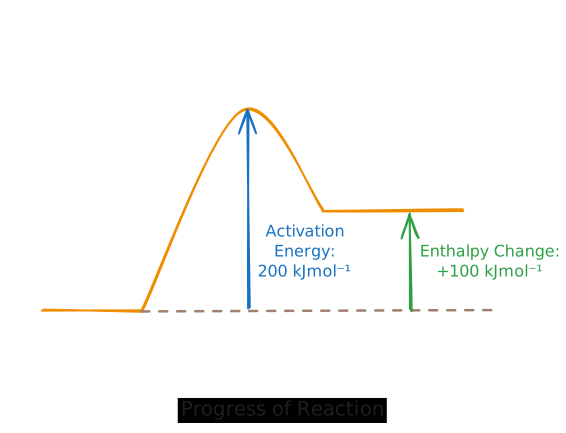
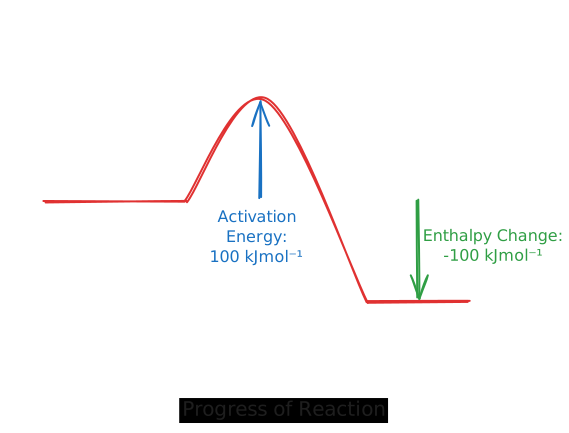
Pathway diagram for forward reaction (endothermic)Pathway diagram for backward reaction (exothermic)
Case 1: Temperature is increased 10 Kelvin (from 300K to 310K).
We will compare the two reactions (forward and backward) when the temperature rises by
Forward Reaction (endothermic): (High )
Backward Reaction (exothermic): (Low )
Note: We must convert to Joules ( and ) to match the Gas Constant. We will ignore '' for now as it stays roughly constant.
Scenario A: The High Reaction (Endothermic)
At 300 K:
At 310 K:
Result: The rate increased by a factor of:
Scenario B: The Low Reaction (Exothermic)
At 300 K:
At 310 K:
Result: The rate increased by a factor of:
Conclusion
Look at the difference:
The High reaction speed increased by 13.3 times
The Low reaction speed increased by 3.63
Because the Endothermic reaction will always have the highest :
When temperature is increased, the rate of the endothermic reaction will always increase more than the rate of the exothermic reaction.
Equilibrium will shift to the endothermic direction.
Case 2: Temperature is decreased 10 Kelvin (from 310K to 300K).
We will compare the two reactions (forward and backward) when the temperature decreases by
Forward Reaction (endothermic): (High )
Backward Reaction (exothermic): (Low )
Note: We must convert to Joules ( and ) to match the Gas Constant. We will ignore '' for now as it stays roughly constant.
Scenario A: The High Reaction (Endothermic)
At 310 K:
At 300 K:
The Drop::
Interpretation: The rate has crashed, it only retains 7.5% of its original speed.
Scenario B: The Low Reaction (Exothermic)
At 310 K:
At 300 K:
The Drop::
Interpretation: The rate has slowed down, but it retains 28% of its original speed.
Conclusion
Look at the difference:
The High reaction slowed down drastically, running at 7.5% of its original speed
The Low reaction slowed down by a lesser extent, running at 28% of its original speed.
Because the Endothermic reaction will always have the highest :
When temperature is decreased, the rate of the endothermic reaction will always slow down more than the rate of the exothermic reaction.
Equilibrium will shift to the exothermic direction.
3. Pressure
Prerequisites for pressure to affect position of equilibrium
Pressure changes only affect the position of equilibrium if:
The reaction involves gases.
There is a different number of moles of gas on the reactant side compared to the product side.
(If there are 2 moles of gas on the left and 2 moles on the right, changing pressure has no effect on the position of equilibrium, although it will increase the rate of both forward and backward reaction).
Note: The reaction may also involve non gaseous substances, as long as at least one gaseous substance is present, pressure will affect the position of equilibrium.
Consider the following reaction:
Case 1: Increasing Pressure
The Rule:
If the pressure is increased, the equilibrium shifts to the side with fewer moles of gas.
The Explanation (Le Chatelier’s Principle):
Change: Pressure is increased (volume is decreased).
Response: The system acts to minimize this increase in pressure.
Mechanism: Pressure is caused by gas particles hitting the walls of the container. To reduce pressure, the system must reduce the number of particles hitting the walls.
Action: It shifts towards the side with fewer gas molecules.
Case 2: Decreasing Pressure
The Rule:
If the pressure is decreased, the equilibrium shifts to the side with more moles of gas.
The Explanation (Le Chatelier’s Principle):
Change: Pressure is decreased (volume is increased)
Response: The system acts to minimize the pressure drop.
Action: To increase pressure, the system needs to generate more gas particles to hit the walls.
Shift: It shifts towards the side that produces more gas molecules.
4. Catalyst
Effect of catalyst on position of equilibrium
A catalyst has NO effect on the position of equilibrium
Why does a catalyst not affect position of equilibrium?
Mechanism: A catalyst provides an alternative reaction pathway with a lower activation energy .
Symmetry: It lowers the activation energy for both the forward and backward reaction by the same amount.
Rates: Consequently, the rate of the forward reaction and the rate of the backward reaction increase by the same factor.
Result: Since Both rates speed up equally, the ratio between them remains unchanged. The system remains in equilibrium (or reaches it faster), but the relative concentration of reactants and products does not change
Extra Info: Position of equilibrium shifting
Consider the following reaction:
The of this reaction is given by:
If there is only reactants and no products,
If there is only products and no reactants,
Lets say that at equilibrium we have the following concentrations:
Then,
1. The Setup: The Number Line
Imagine a number line that ranges from zero to infinity that represents .
0 = All Reactants (The far Left)
Infinity = All Products (The far Right)
2. The Anchor: The Equilibrium constant ()
Place an immovable Anchor on this line. This is your Equilibrium Constant ().
For our specific reaction, .
The anchor is planted permanently at 0.5.
Because 0.5 is less than 1, the position of equilibrium lies to the left.