Explain why transition elements can form coloured complexes
Repulsion between d-electrons and lone pairs on ligands cause the d-subshell to split into two sets of non degenerate d-orbitals.
An electron from the lower energy d-orbital absorbs a photon having a specific frequency of visible light and is promoted to a higher energy d-orbital.
The absorbed frequency is missing from the transmitted light therefore the complementary colour is seen.
d-d Splitting Due to Ligands
Isolated Metal Ion
In an isolated metal ion, the orbitals are degenerate.
3d orbitals have the same energy (degenerate)|
Splitting in Tetrahedral Complexes
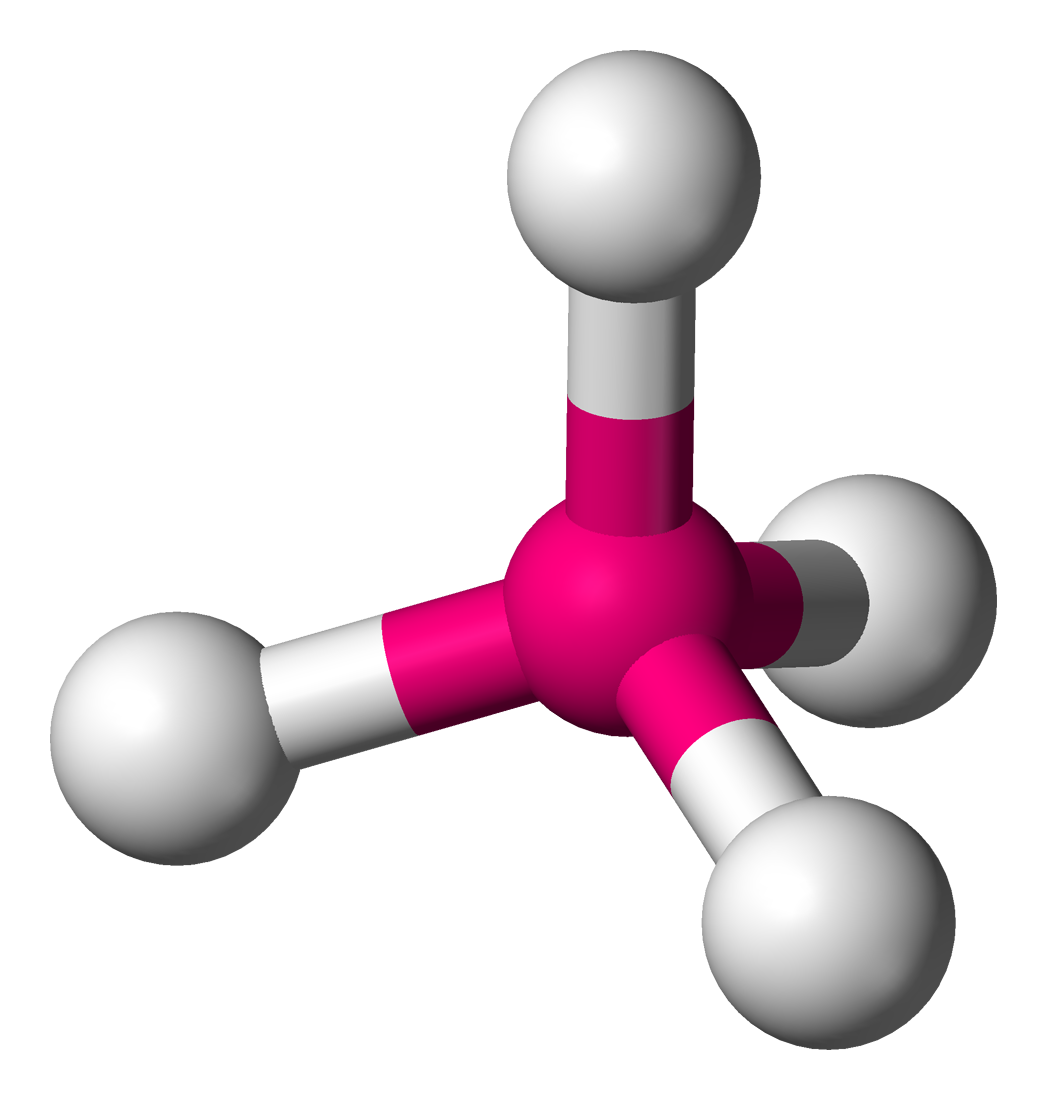
Tetrahedral Molecular Geometry
Tetrahedral molecular geometry
Key features:
4 ligands attached to a central metal ion.
Bond angle of
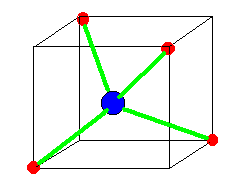
Tetrahedral shape from cube
The tetrahedral shape can be thought of as resulting from alternating corners of a cube.
How ligands approach central metal ion in tetrahedral complexes
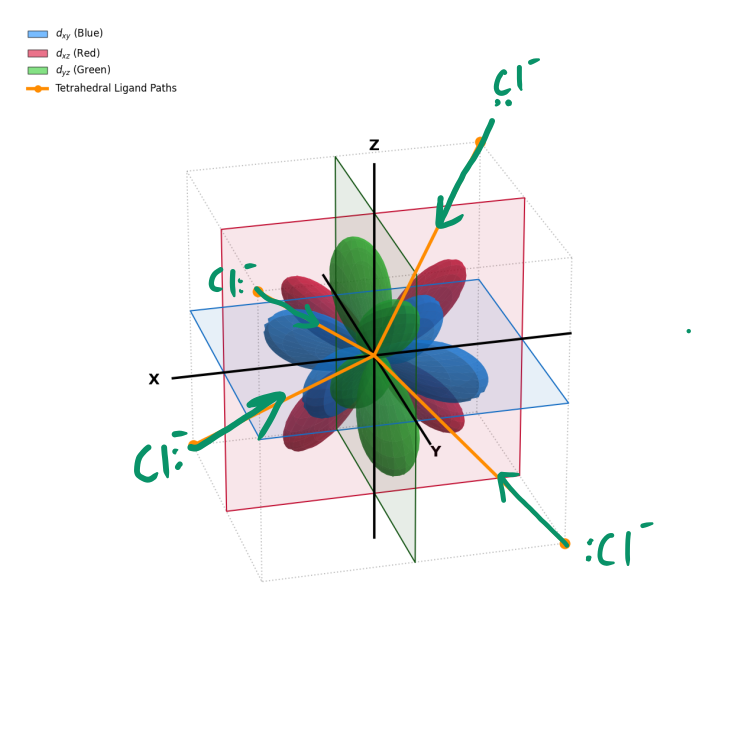
Approach of ligands in a tetrahedral complex
Direction of Ligand Approach
In a tetrahedral shape, four ligands approach the central metal ion from alternating corners of a cube containing the metal ion at its centre.
Importantly, these directions do not lie along the , and axes. Instead, the ligands approach in between the axes.
Electrostatic Interaction
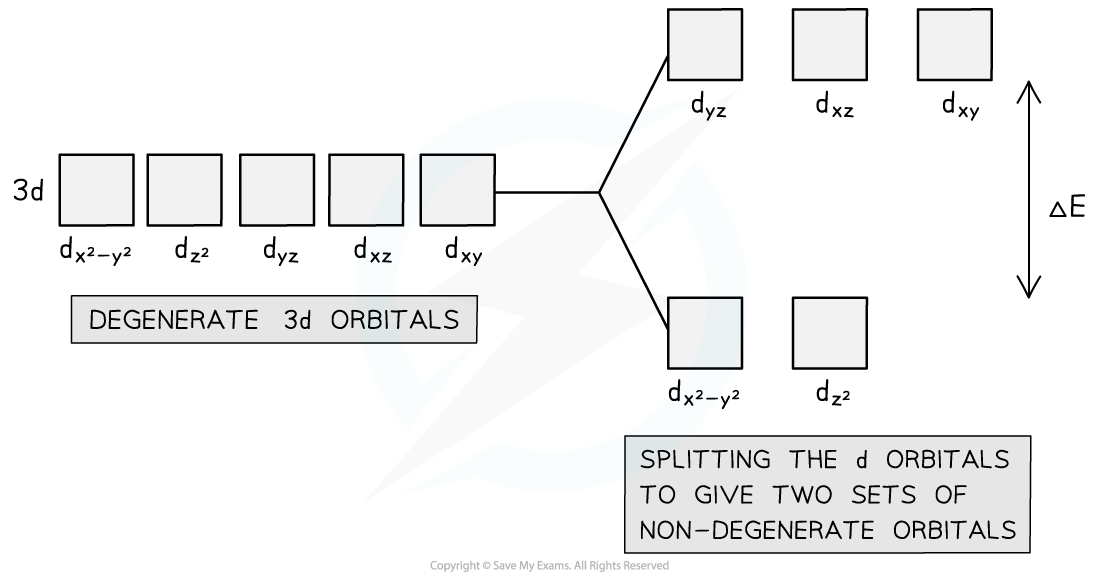
The lobes of the , and orbitals point in the regions between the axes. Therefore, they point much closer to the approaching ligands. This results in greater electrostatic repulsion for these 3 orbitals.
The and orbitals point along the axes, which are further away from the path of the incoming ligands. They experience less repulsion
Resulting Energy Levels
Due to more repulsion from ligands, the , and orbitals are at a higher energy level.
Due to less repulsion from ligands, the and are at a lower energy level.
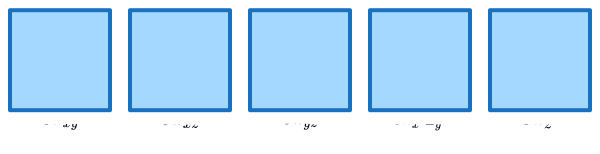
d-d splitting in tetrahedral complexes
Splitting in Octahedral Complexes
Octahedral Molecular geometry
Octahedral molecular geometry
Key features
bond angle
Shape coincides with Cartesian axes (, , )
How ligands approach central metal ion in octahedral complexes
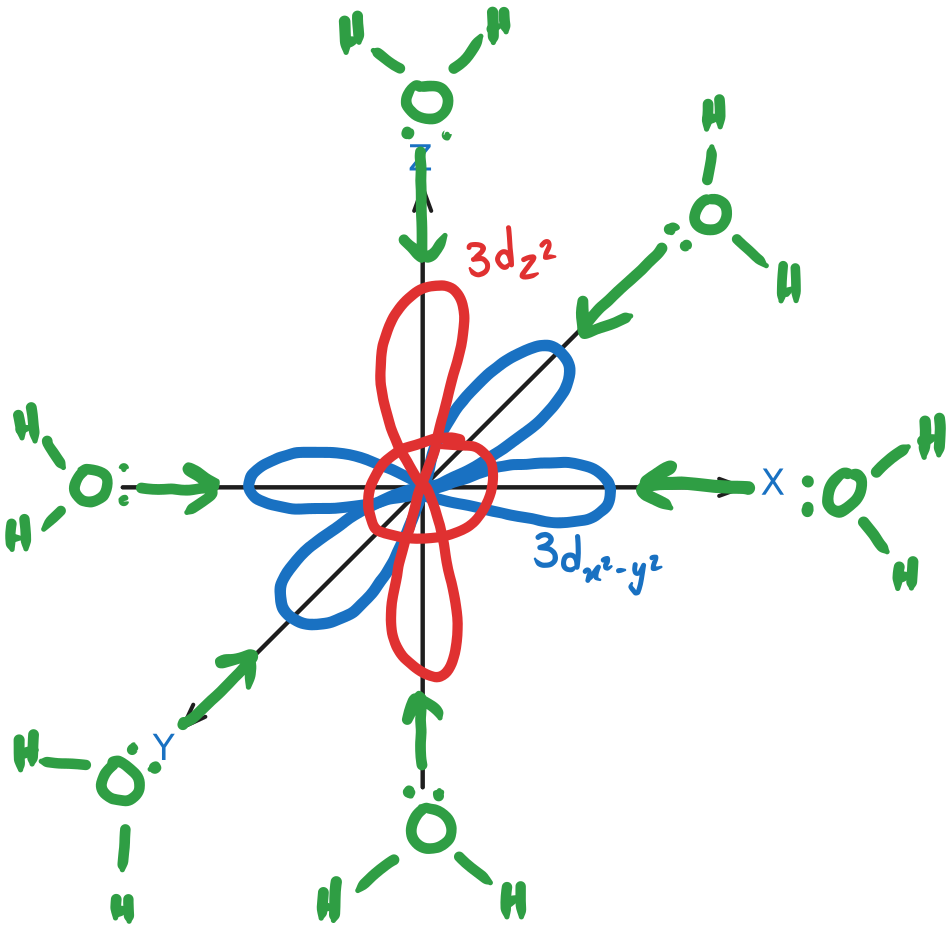
Approach of ligands in octahedral complex
Direction of Ligand Approach
In an octahedral shape, six ligands approach the central metal ion directly along the , and axes
Electrostatic Interaction
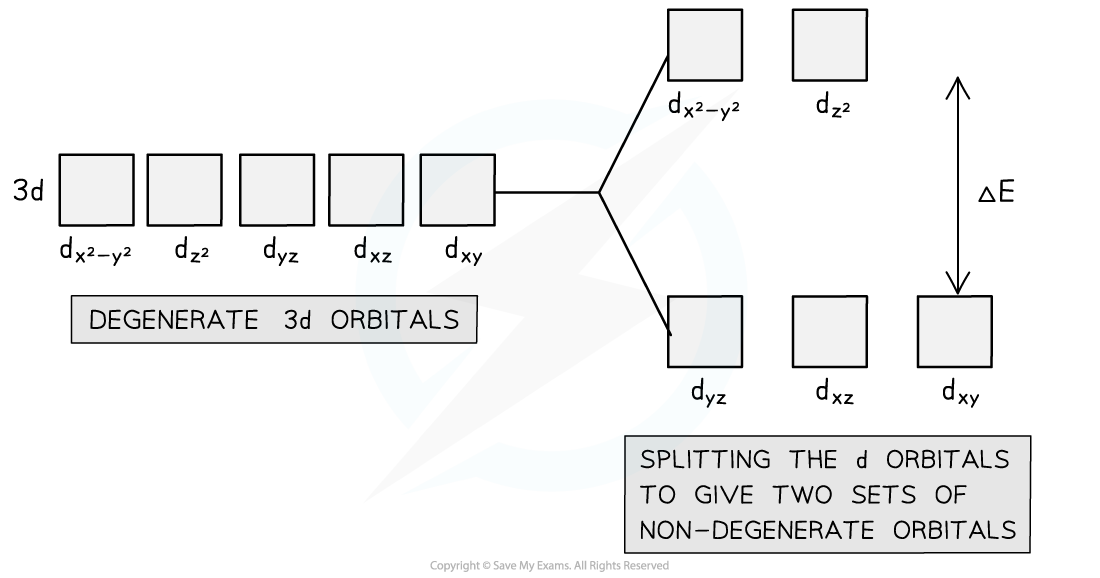
The lobes of the and orbitals point directly at the approaching ligands. This results in maximum electrostatic repulsion.
The lobes of the , , and orbitals point between the axes, away from the direct line of approach of the ligands. They experience less repulsion.
Resulting Energy Levels
Due to more repulsion from ligands, the and are at a higher energy level.
Due to less repulsion from ligands, the , and orbitals are at a lower energy level.