1. Atomic Radius
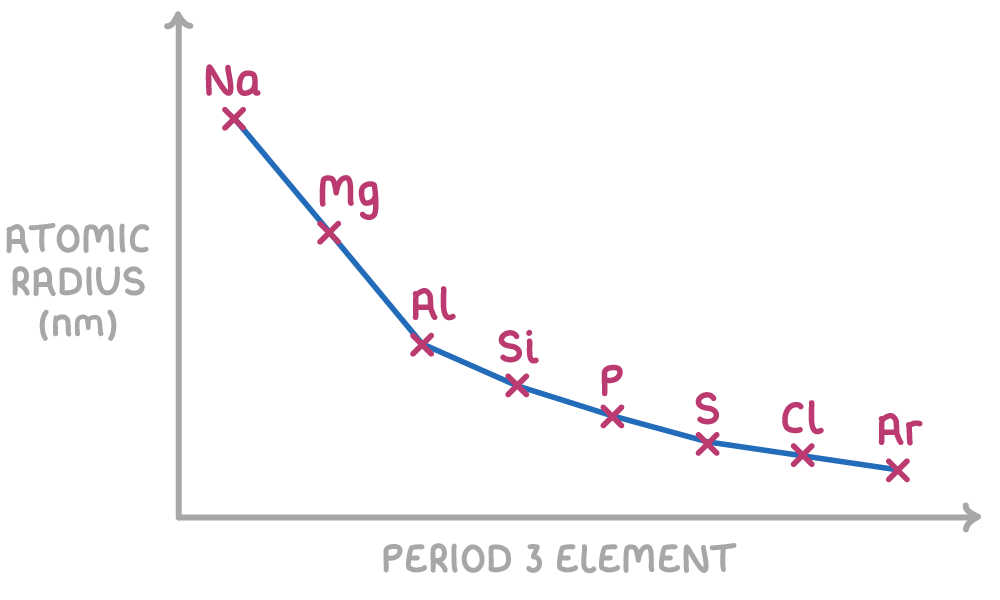
Trend in Atomic Radius Across Period 3
Trend:
- Atomic radius decreases.
Explanation:
- Across period 3, nuclear charge increases.
- Shielding effect remains relatively unchanged as new electrons are added to the same principal quantum shell.
- Outermost electrons experience a greater effective nuclear charge and are pulled closer towards the nucleus.
2. Ionic Radius
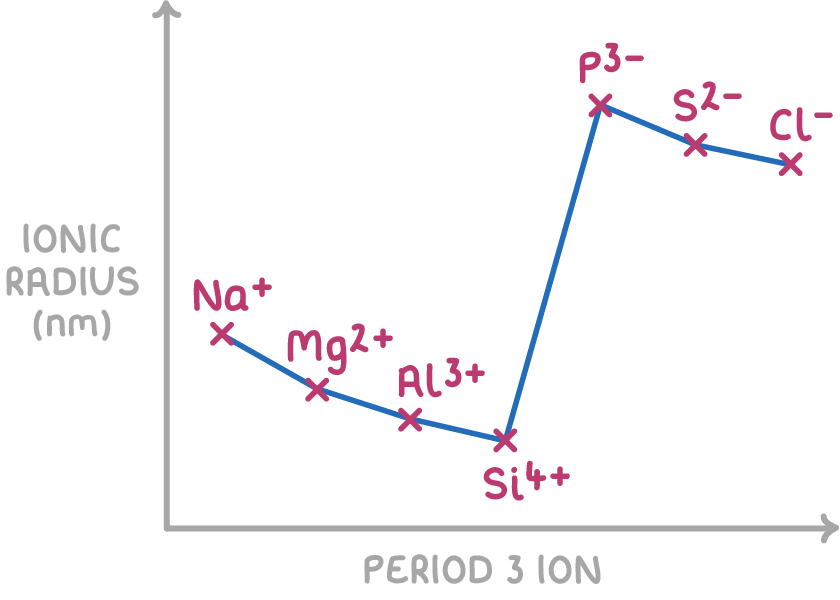
A. Trend for Cations (
Cation vs. Parent Atom
- Cations are smaller than their parent atoms.
Explanation:
- The parent atom loses electron shells to form a cation.
- Interelectronic repulsion decreases.
- Remaining electrons are pulled closer to the nucleus.
Trend in Cationic Radius Across Period 3
Trend:
- Cationic radius decreases.
Explanation:
- Across period 3, nuclear charge increases.
- Shielding effect remains relatively unchanged as new electrons are added to the same principal quantum shell.
- Outermost electrons experience a greater effective nuclear charge and are pulled closer towards the nucleus.
B. Trend for Anions (
Anion vs. Parent Atom
- Anions are larger than their parent atoms.
Explanation:
- The parent atom gains an electron shell to form an anion.
- Interelectronic repulsion increases causing the electrons to spread further from the nucleus.
Trend in Anionic Radius Across Period 3
Trend:
- Anionic radius decreases.
Explanation:
- Across period 3, nuclear charge increases.
- Shielding effect remains relatively unchanged as new electrons are added to the same principal quantum shell.
- Outermost electrons experience a greater effective nuclear charge and are pulled closer towards the nucleus.
3. Melting Point
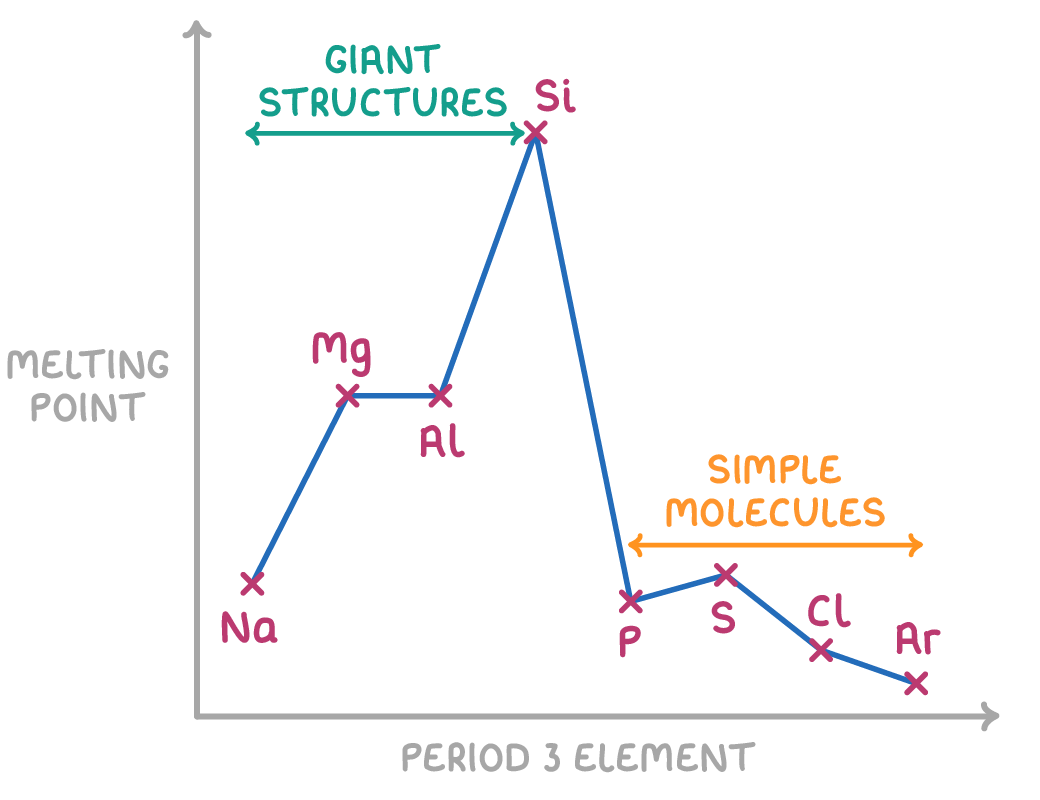
Trend in Melting Points from
to Trend:
- Melting point increases
Explanation:
Increase in delocalised electrons: From
to , the number of valence electrons contributed per atom to the sea of delocalised electrons increases ( , , ). Decrease in ionic radius: The resulting cations (
, , ) are isoelectronic (they all have 10 electrons), but the nuclear charge increases due to the increasing number of protons. This stronger nuclear pull draws the electron shells closer, decreasing the ionic radius. Increase in charge density: Because the ionic charge increases and the ionic radius decreases from
to , the charge density of the cations increases significantly. Stronger metallic bonding: The combination of a higher concentration of delocalised electrons and cations with higher charge density results in stronger electrostatic forces of attraction (metallic bonds). This requires more thermal energy to overcome, thereby increasing the melting point.
Melting Point of
has the highest melting point in period 3. Explanation:
has a giant molecular lattice structure. - Each silicon atom is covalently bonded to four neighbouring silicon atoms in a rigid tetrahedral arrangement.
- A large amount of energy is needed to overcome the large number of covalent bonds.
Factors Affecting Melting Point
- These elements exist as non polar molecules/atoms.
- The only force between the molecules/atoms is instantaneous dipole-induced dipole forces.
- The strength of these forces depends on the number of electrons per molecule/atom.
- The more electrons, the greater the strength of the instantaneous dipole-induced dipole forces and the higher the melting point.
Order of Decreasing Melting Point
4. Electrical Conductivity
Trend in Conductivity from
to Trend:
- Conductivity increases
Explanation:
- Number of delocalised electrons contributed to the sea of electrons per atom increases.
- More charge carriers are available to move throughout the structure to carry electric charges.
Conductivity
- Poor conductivity
Explanation:
- There are no delocalised electrons that can move throughout the structure to carry electric charges.