A d-block element which forms one or more stable ions with incomplete d-orbitals.
Chemical Properties of Transition Elements
Variable oxidation states
Act as catalysts
Form coloured compounds
Form complex ions
Why Transition Elements have Variable Oxidation States
The 3d and 4s sub-shells are close in energy.
Why calcium does not show variable oxidation states
The energy gap between the outer s-orbital and the next inner orbital is too large
Info
Electronic configuration of copper
Why electronic configuration of copper is not
The fully-filled 3d subshell offers extra stability
Electronic configuration of chromium
Why electronic configuration of copper is not
The half-filled 3d subshell offers extra stability
Orbitals
Definition: Degenerate orbitals
Orbitals that have the same energy
Definition: Non-degenerate orbitals
Orbitals that do not have the same energy
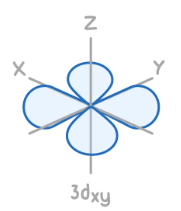
Orbital
3d_{xy} orbital
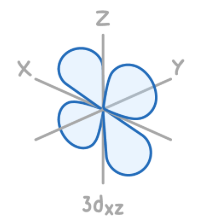
Orbital
3d_{xz} orbital
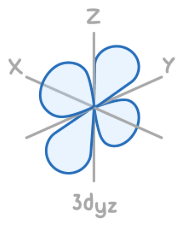
Orbital
3d_{yz} orbital
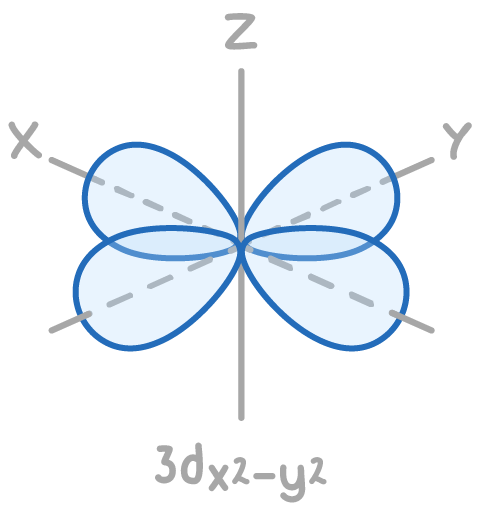
Orbital
3d_{x^2-y^2} orbital
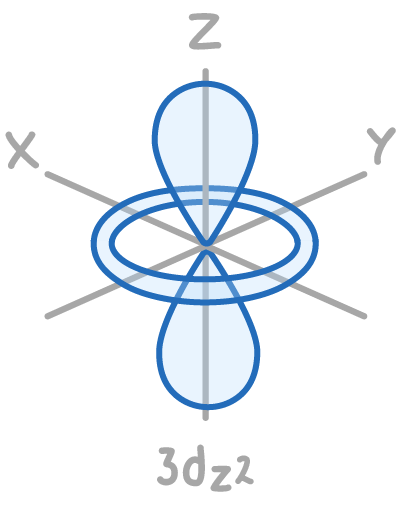
Orbital
3d_{z^2} orbital
Catalysis
Why do transition elements behave as catalysts
They have more than one stable oxidation state.
They have vacant d-orbitals that are energetically accessible to accept lone pairs to form dative bonds with ligands.
Todo
Hetero and homo catalysis
Ligands and Complexes
Definition: Complex ion
A species formed by a central metal ion bonded to one or more ligands.
Definition: Ligand
A species that contains lone pairs of electrons that form dative bonds with a central metal ion.
Definition: Monodentate Ligand
A species that uses one lone pair of electrons to form a single dative bond to a central metal atom.
Definition: Bidentate Ligand
A species that uses two lone pairs of electrons to form two dative bonds to a central metal atom.
Definition: Polydentate Ligand
A species that donates more than two lone pairs of electrons
to form more than two dative bonds to a central metal atom
Definition: Coordination number
Total number of coordinate bonds being formed by the metal ion.
Why transition elements form complex ions
They have vacant d-orbitals that are energetically accessible to accept lone pairs from ligands.
Reactions of
Add dropwise or
Product
Equation (Dropwise )
Equation (Dropwise dil. )
Type of Reaction
Deprotonation
Acid-Base
Precipitation
Warning
⚠️ THIS IS NOT A LIGAND EXCHANGE REACTION ⚠️
Copper(II) Hexaaqua + Dropwise NaOH
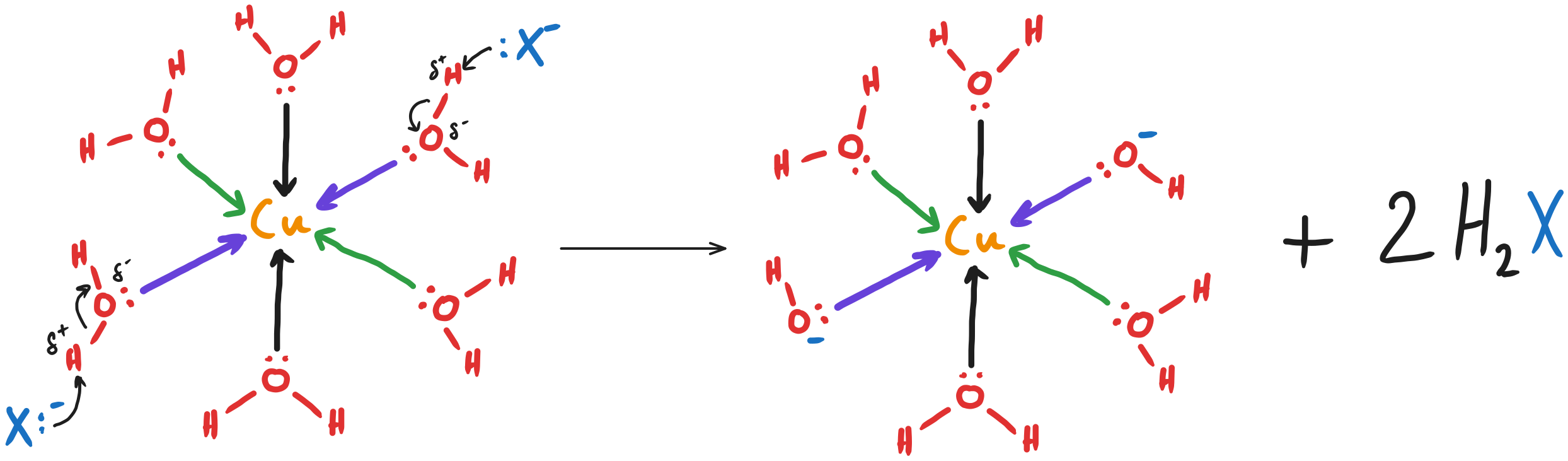
When a few drops of or dilute are added to hexaaquacopper(II), no coordinate bonds are broken.
The Mechanism: The incoming (or ) acts strictly as a Brønsted-Lowry base, accepting protons () from two coordinated water molecules.
In-situ conversion: The coordinated ligands are deprotonated directly on the central metal atom to become ligands.
The product: The water molecules formed on the product side of the reaction are generated by acid–base neutralisation (), not displaced ligands leaving the coordination sphere!