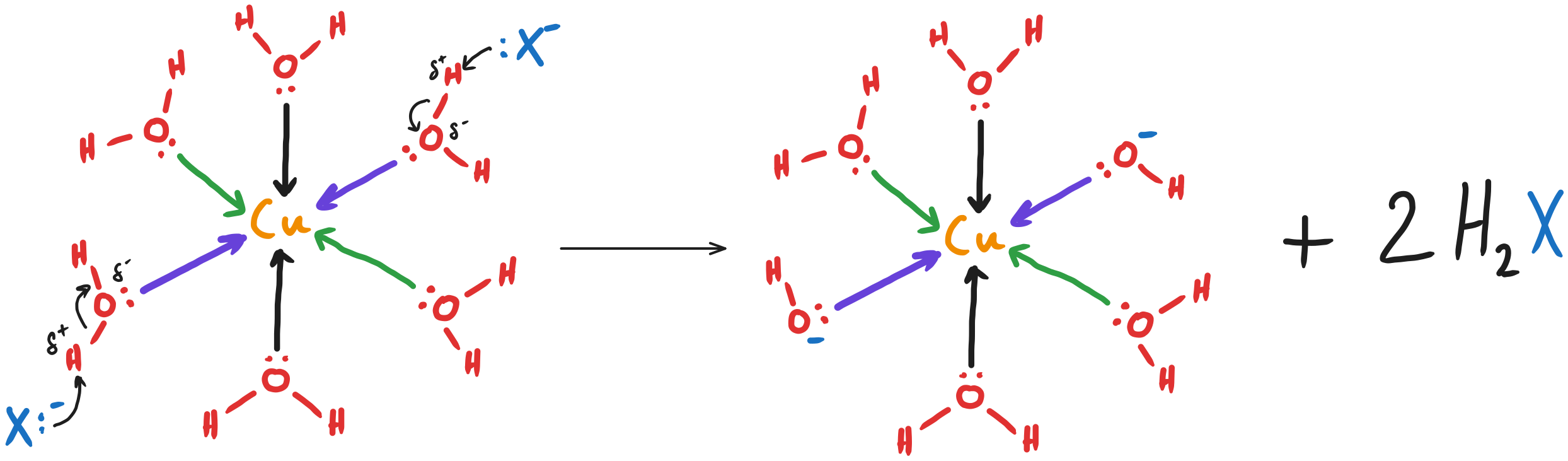
Negatively charged Bronsted-Lowry base directly abstracts hydrogen atoms from the ligands.
Due to the Jahn-Teller effect the axial bonds are longer, it is more energetically favourable to have the resulting negatively charged ligands on the shorter equatorial bonds so they are closer to the positively charged central metal ion.
After two ligands get deprotonated, the central metal ion loses its charge. It no longer pulls electron density towards it making the remaining bonds stronger.
That is why reaction stops after two deprotonations.
Type of Reaction
Deprotonation
Acid-Base
Precipitation
Observations
Pale blue solution forms a pale blue precipitate
Notes & Nuances
Why is a precipitate formed
The complex loses its charge (becomes neutral), so it can no longer form strong ion-dipole bonds with water molecules.
S
Copper(II) + Dropwise
Equation
Mechanism
Deprotonation Reaction
Tip
Negatively charged Bronsted-Lowry base directly abstracts hydrogen atoms from the ligands.
Due to the Jahn-Teller effect the axial bonds are longer, it is more energetically favourable to have the resulting negatively charged ligands on the shorter equatorial bonds so they are closer to the positively charged central metal ion.
After two ligands get deprotonated, the central metal ion loses its charge. It no longer pulls electron density towards it making the remaining bonds stronger.
That is why reaction stops after two deprotonations.
Type of Reaction
Deprotonation
Acid-Base
Precipitation
Observations
Pale blue solution forms a pale blue precipitate
Notes & Nuances
Why is a precipitate formed
The complex loses its charge (becomes neutral), so it can no longer form strong ion-dipole bonds with water molecules.
+ Excess
Equation
Mechanism
copper_2_hexaaqua_nh3_ligand_exhange
Tip
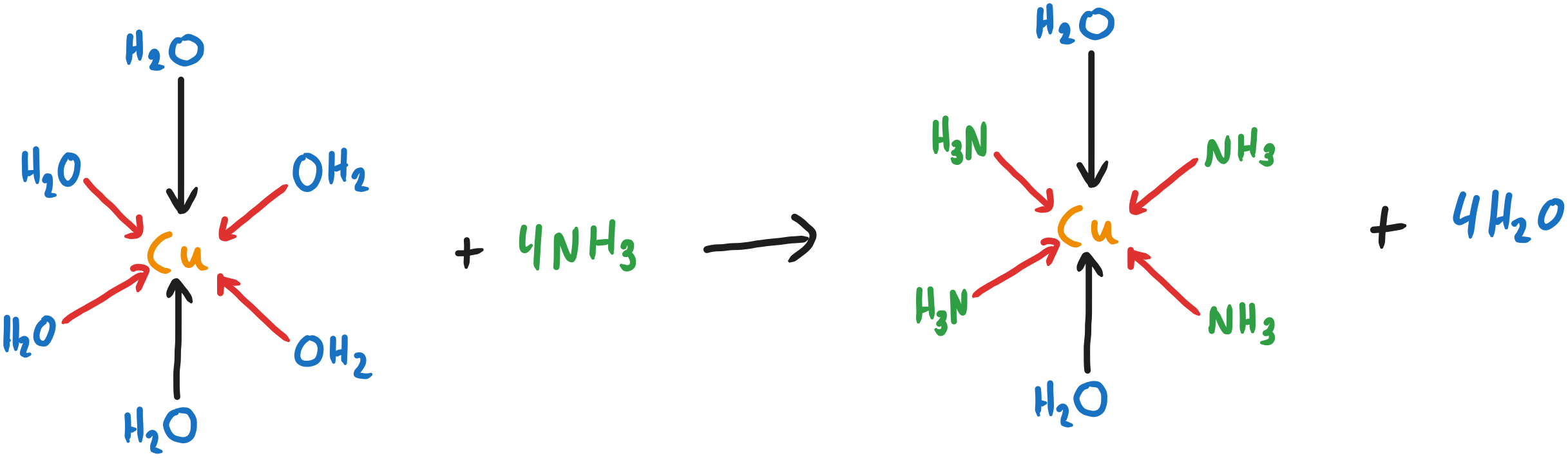
is a stronger ligand than
So, bonds are stronger than .
It is energetically favourable for to substitute ligands as forming the strong bonds releases a lot of energy.
Due to the Jahn-Teller effect, the axial bolds are longer and weaker, it is energetically unfavourable to substitute those ligands.
Therefore the most energetically stable configuration is 4 ligands on the equatorial positions.
NO MATTER WHAT THAT IS WHAT HAPPENS WITH A COMPLEX IN AQUEOUS MEDIUM
Type of Reaction
Ligand Exchange
Observations
Pale blue solution turns into a deep blue solution
+ Excess
Equation
Mechanism
tetraaquadihydroxocupper_2_nh3_ligand_exchange
Tip
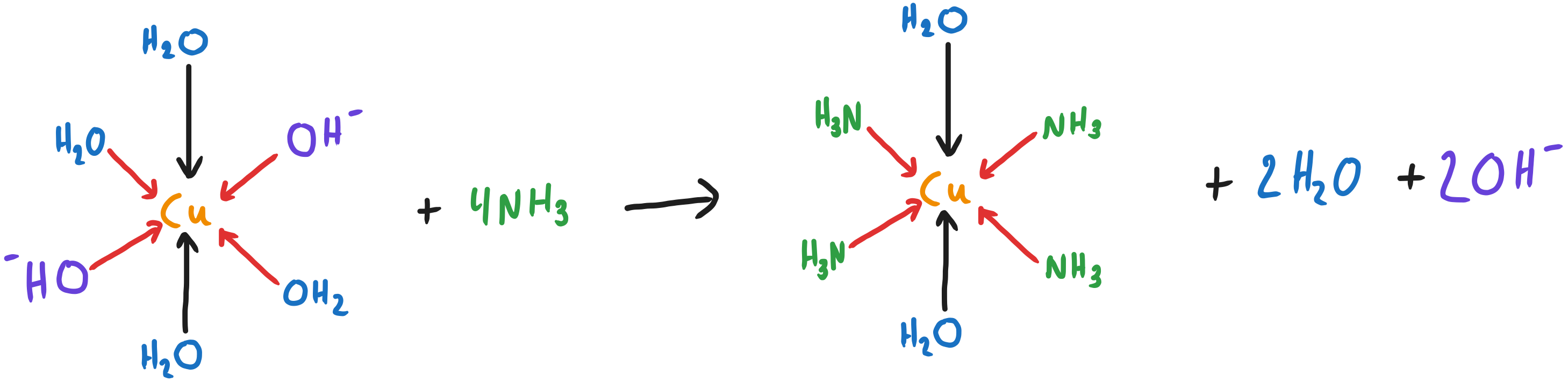
Copper (II) complexes are labile, this means that the bonds break and reform many times per second.
It is more energetically favourable for the ligands to be in the equatorial positions opposite to each other to minimise repulsion between them and maximise attraction to .
is a stronger ligand than and
So, bonds are stronger than and .
It is energetically favourable for to substitute and ligands as forming the strong bonds releases a lot of energy.
Due to the Jahn-Teller effect, the axial bolds are longer and weaker, it is energetically unfavourable to substitute those ligands.
Therefore the most energetically stable configuration is 4 ligands on the equatorial positions.
NO MATTER WHAT THAT IS WHAT HAPPENS WITH A COMPLEX IN AQUEOUS MEDIUM
Type of Reaction
Ligand Exchange
Observations
Pale blue precipitate dissolves to form a deep blue solution
Notes & Nuances
Tip
The precipitate dissolves because the resulting complex is charged and can form ion-dipole bonds with water molecules.
Copper(II) + Concentrated
Equation
Mechanism
copper_2_hexaaqua_cl_ligand_exchange
Tip
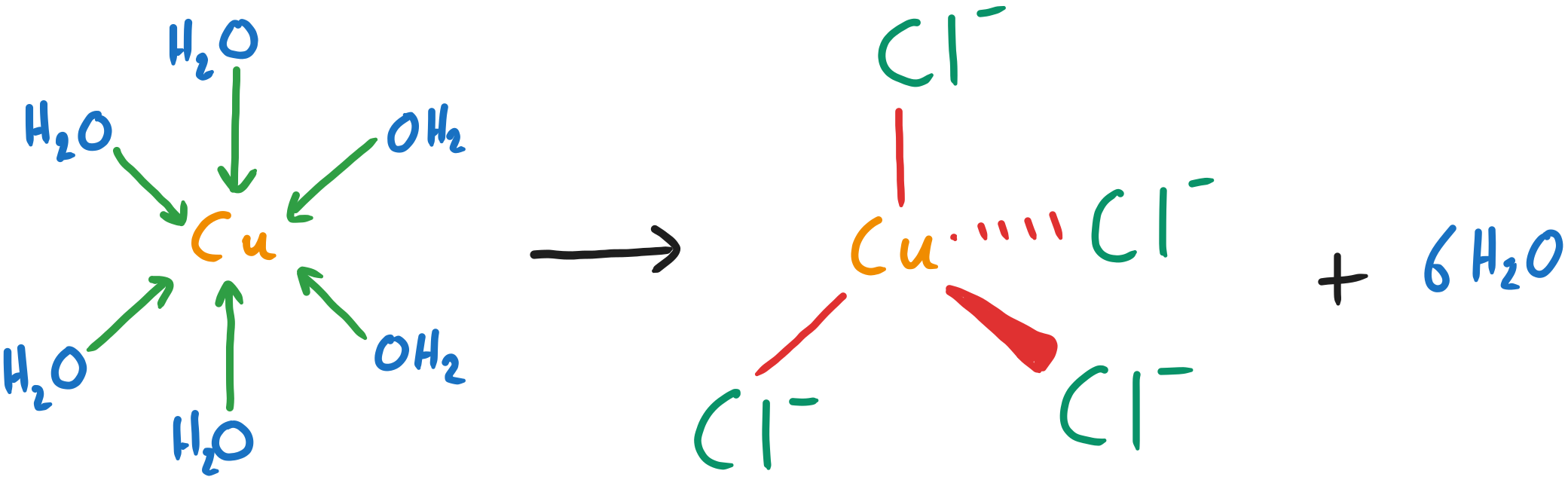
is a much larger ligand than .
There is only enough space to have 4 ligands
Additionally, since the ligands are negative charged, they repel each other and adopt a tetrahedral shape to minimise repulsion.
Type of Reaction
Ligand Exchange
Observations
Pale blue solution turns into a yellow solution
(Often appears green during transition because blue + yellow = green, but the final mark scheme answer is yellow).
The colour can be changed through Le Chatelier’s principle since the reaction is reversible:
Adding water favours the backwards reaction in order to decrease water concentration. Making the solution more blue.
Adding more favours the forwards reaction in order to decrease concentration. This makes the solution more yellow.
Notes & Nuances
Tip
Coordination number changes from 6 to 4.
The geometry changes from octahedral to tetrahedral. This is because the ligands are larger and only 4 of them can fit. Additionally, they adopt a tetrahedral shape to minimise repulsion between them.
is a weaker ligand than , to overcome this concentrated must be used.
This reaction is energetically feasible because 5 particles (1 complex + 4) turn into 7 particles (1 complex + 6 ). There is an increase in entropy.
Cobalt
Cobalt
Cobalt(II) + Dropwise
Equation
Mechanism
cobalt_ii_hexaaqua_deprotonation
Tip
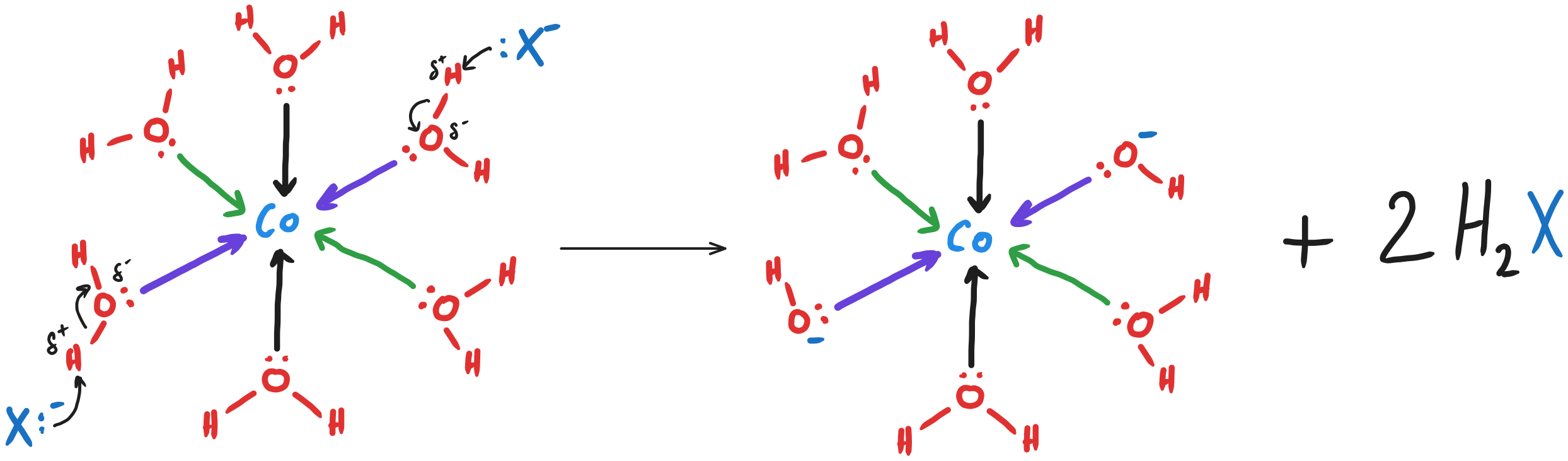
The negatively charged Brønsted–Lowry base () directly abstracts hydrogen ions () from the coordinated ligands.
Unlike , has a negligible Jahn–Teller effect ( orbitals are symmetrically half-filled, ), so all six coordination sites are equivalent in length.
After two ligands get deprotonated, the central metal ion loses its charge. It no longer pulls electron density towards it making the remaining bonds stronger.
That is why reaction stops after two deprotonations.
Type of Reaction
Deprotonation
Acid-Base
Precipitation
Observations
Pink solution forms a blue precipitate (which may turn pink/red on standing, but blue precipitate is the primary mark scheme answer).
Notes & Nuances
Why is a precipitate formed?
The complex loses its charge (becomes neutral), so it can no longer form strong ion-dipole interactions with water molecules and precipitates out of solution.
Examiner Nuance: This is an acid-base / deprotonation reaction, not a ligand exchange reaction.
Cobalt(II) + Dropwise
Equation
Mechanism
cobalt_ii_hexaaqua_nh3_deprotonation
Tip
In dilute / dropwise conditions, aqueous ammonia acts as a Brønsted–Lowry base, abstracting protons () from the coordinated water molecules.
After two ligands get deprotonated, the central metal ion loses its charge. It no longer pulls electron density towards it making the remaining bonds stronger.
That is why reaction stops after two deprotonations.
Type of Reaction
Deprotonation
Acid-Base
Precipitation
Observations
Pink solution forms a blue precipitate.
Notes & Nuances
Why is a precipitate formed? ), losing its ability to form favourable ion-dipole bonds with bulk solvent.
The complex becomes neutral (
+ Excess
Equation
Mechanism
cobalt_2_hexaaqua_nh3_ligand_exchange
Tip
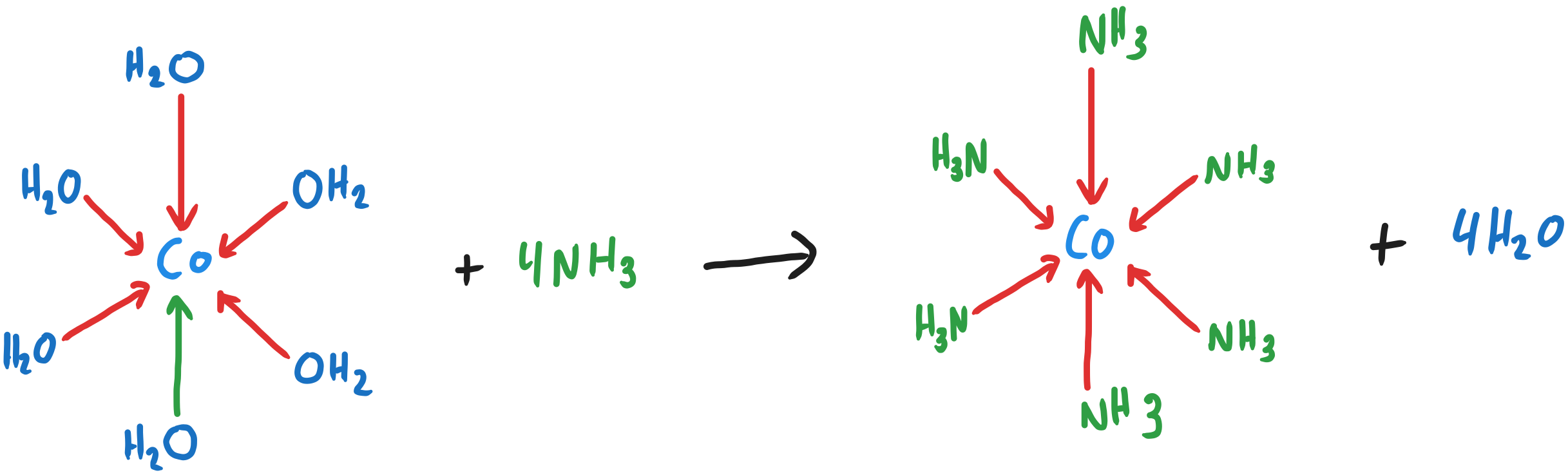
is a stronger ligand (better -donor) than , so bonds are stronger than bonds.
Because does not exhibit significant Jahn–Teller distortion, all six bond lengths are roughly equal.
There are no weakened axial bonds to inhibit full substitution; hence, replaces all six water ligands.
Type of Reaction
Ligand Exchange
Observations
Pink solution turns into a straw / yellow-brown solution.
Notes & Nuances
If this yellow-brown solution is left to stand in air, it darkens to a brown/black solution. Why? Because the Co²⁺ complex is easily oxidised by oxygen in the air to form a stable Co³⁺ complex: [Co(NH₃)₆]³⁺.
+ Excess
Equation
Mechanism
tetraaquadihydroxocobalt_2_nh3_ligand_exchange
Tip
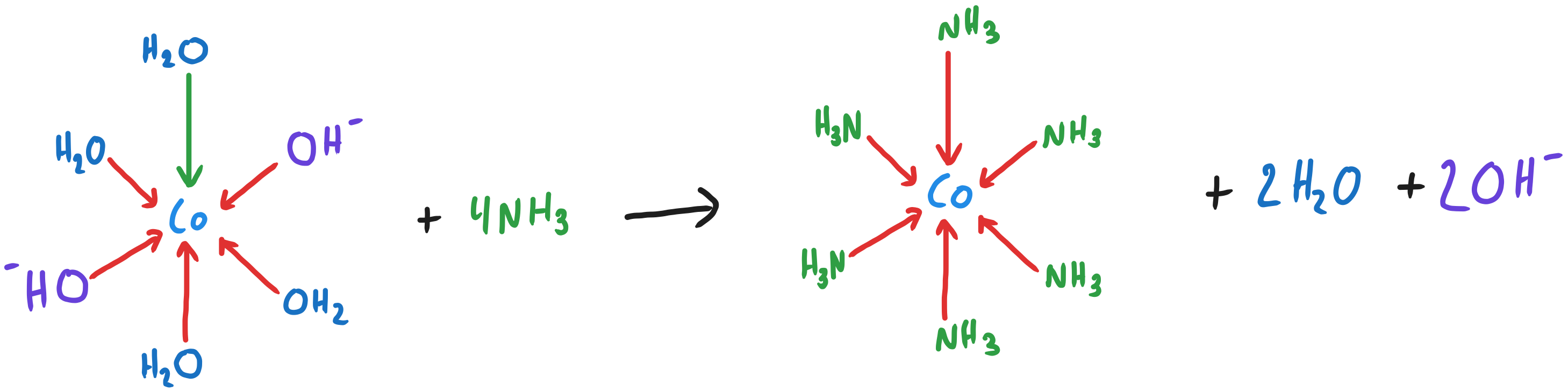
Cobalt(II) complexes are labile, meaning metal–ligand coordinate bonds break and reform rapidly.
is a neutral, stronger ligand than and displaces both the and ligands.
Unlike Copper(II), which stops at 4 due to severe tetragonal elongation, Cobalt(II) substitutes at all 6 octahedral sites.
Type of Reaction
Ligand Exchange
Observations
Blue precipitate dissolves to form a straw / yellow-brown solution.
On standing in air, the solution darkens to a brown / dark brown solution.
Notes & Nuances
Dissolution & Oxidation Nuances
Why it dissolves: The resulting complex ion carries a charge, allowing it to form strong ion-dipole attractions with water.
Examiner Nuance (Air Oxidation): On exposure to air, is readily oxidised by atmospheric oxygen to :
This causes the solution to darken from yellow-brown to deep brown.
Cobalt(II) + Concentrated
Equation
Mechanism
cobalt_2_hexaaqua_cl_ligand_exchange
Tip
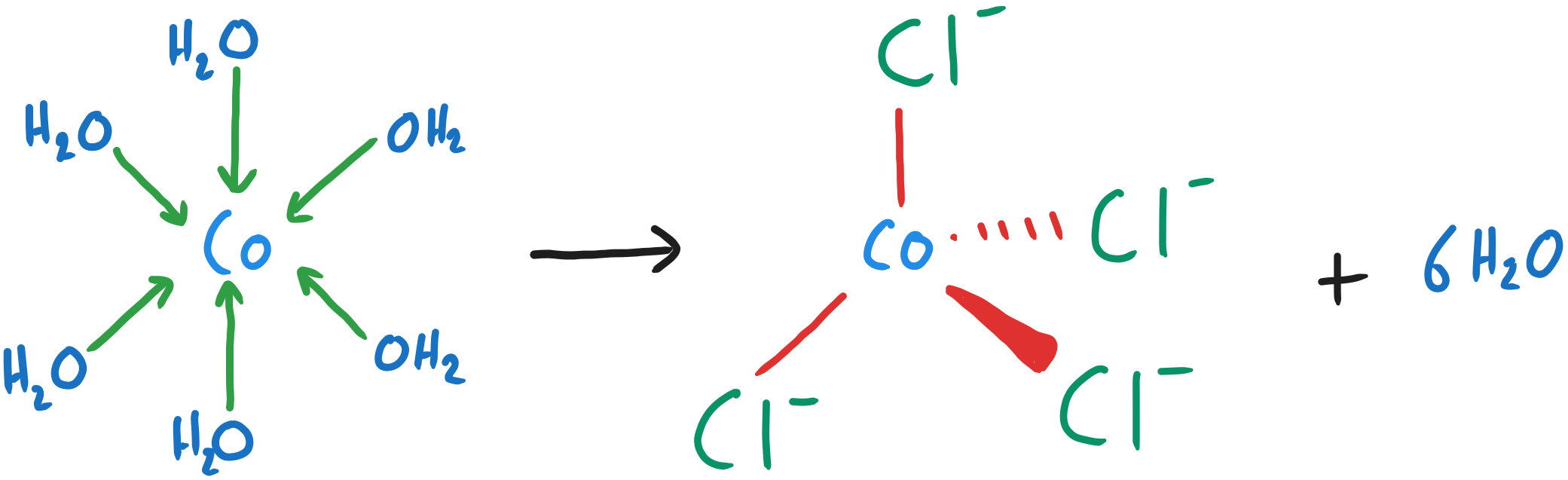
is a larger ligand than .
Due to steric hindrance and electrostatic repulsion between negatively charged chloride ions, only 4 ligands can fit around the ion.
The complex adopts a tetrahedral geometry to minimise repulsion.
Type of Reaction
Ligand Exchange
Observations
Pink solution turns into a blue solution.
The reaction is in dynamic equilibrium and demonstrates Le Chatelier’s principle: