⚛️ Chemical Periodicity: Period 3 Elements
Tags: #alevel-chemistry #periodicity #period-3 #inorganic-chemistry #revision #master-note
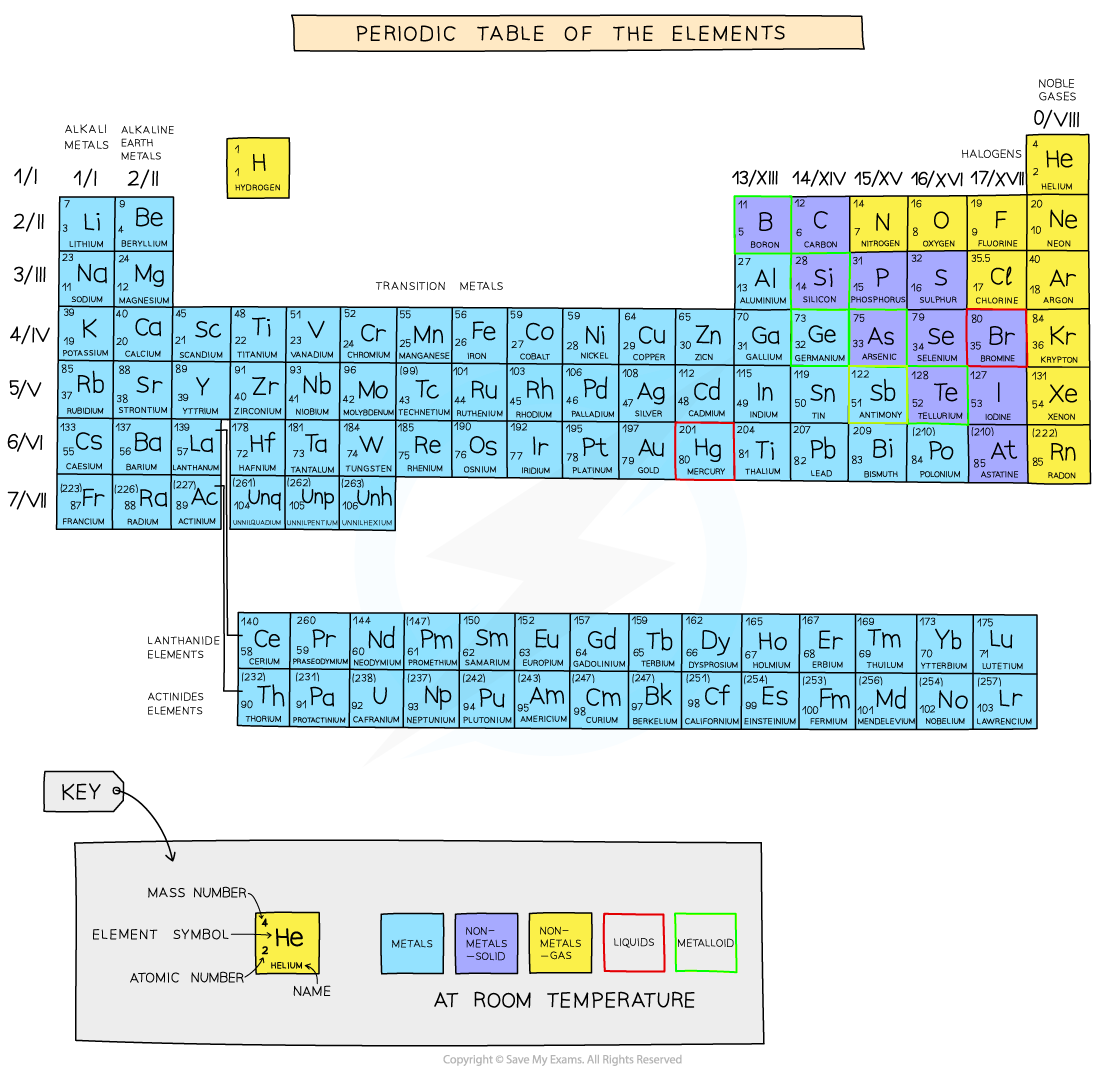
🧱 Phase 1: The Atomic Foundations (The “Why”)
Syllabus Content: 9.1
Describe qualitatively (and indicate the periodicity in) the variations in atomic radius, ionic radius, melting point and electrical conductivity of the elements. Explain the variation in melting point and electrical conductivity in terms of the structure and bonding of the elements. Explain the variations and trends in terms of bonding and electronegativity.
1. Atomic Radius
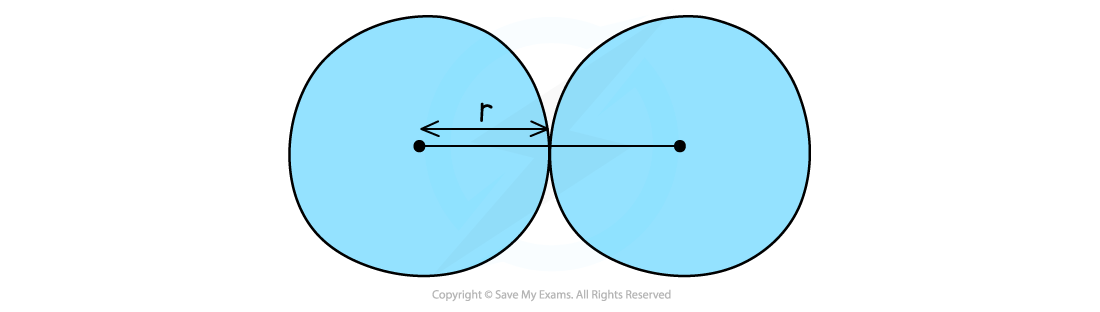
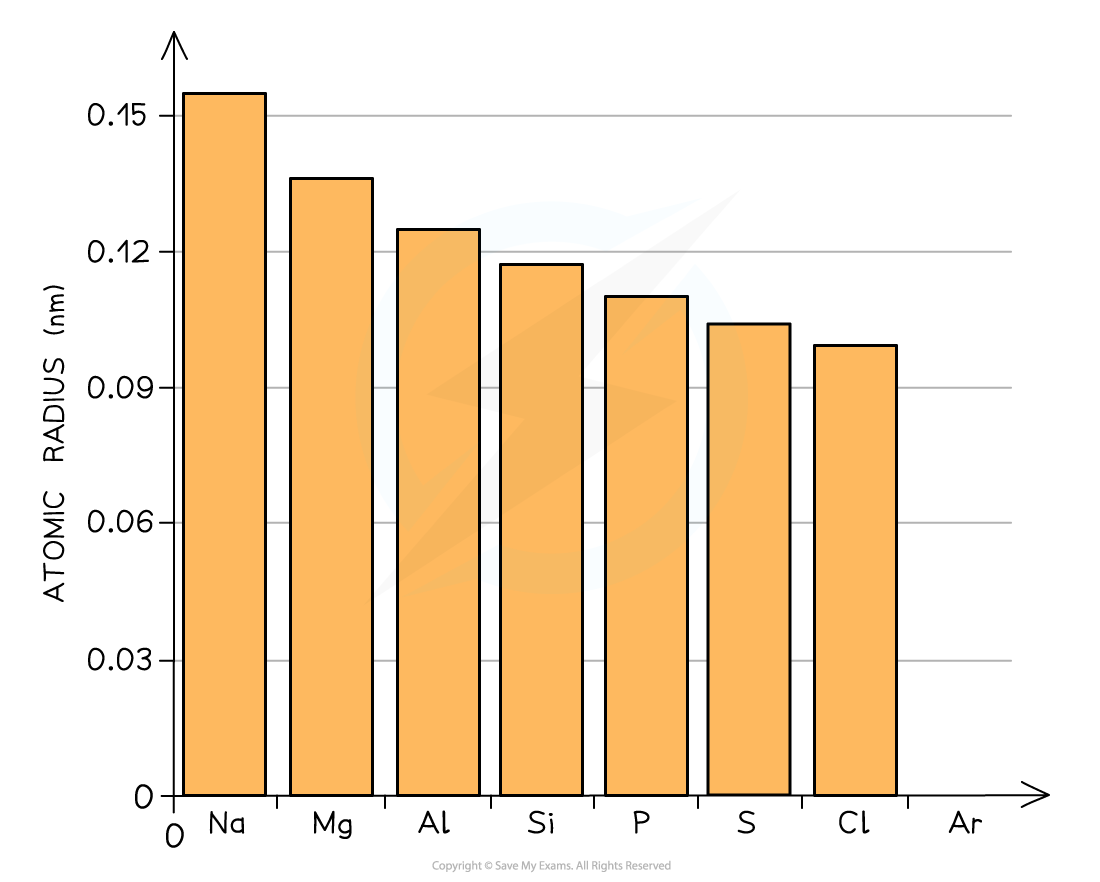
- Trend: Atomic radius decreases across Period 3 (from
to ). - Explanation:
- As you move across the period, the nuclear charge increases (protons are added to the nucleus).
- However, new electrons are added to the same principal quantum shell, meaning the shielding effect remains constant.
- The increasing nuclear charge pulls the outer electrons more strongly, drawing them closer to the nucleus and shrinking the atomic radius.
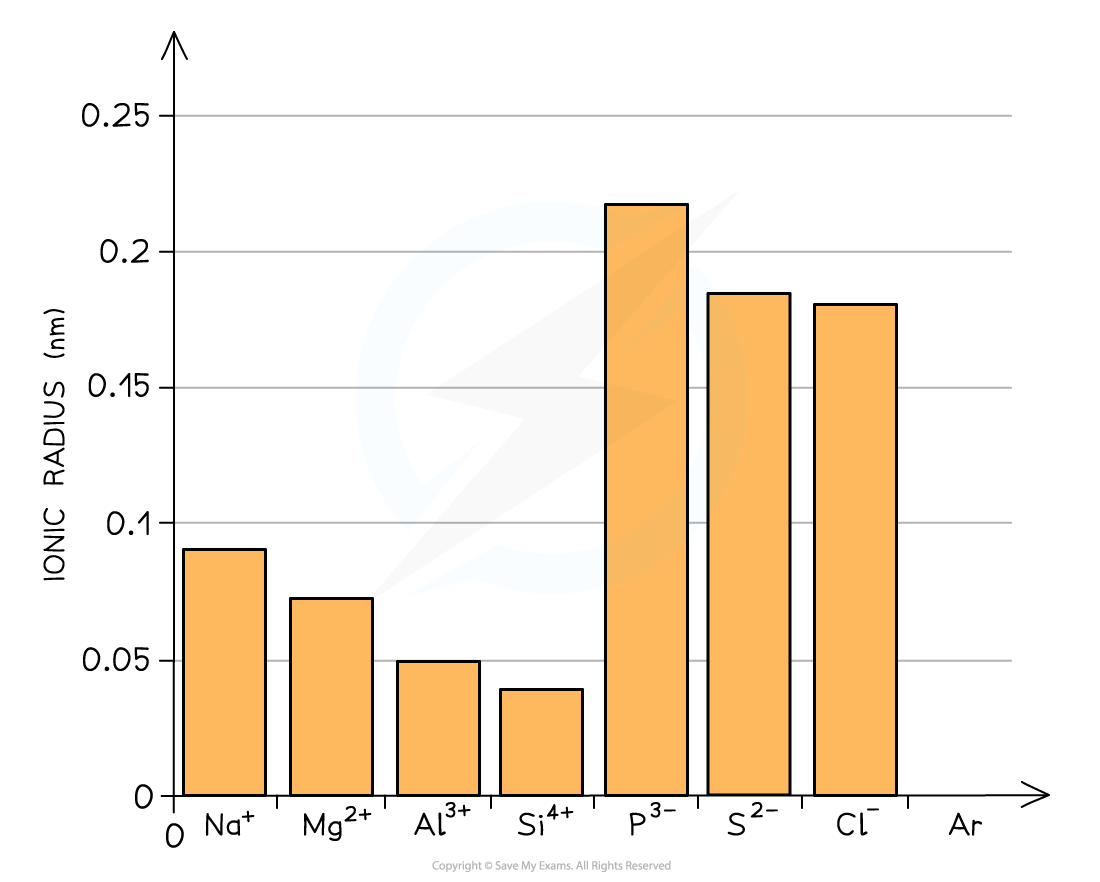
2. Ionic Radius
- Cations (
): - Are smaller than their parent atoms because they have lost their entire outer valence shell. This reduces shielding and increases the effective nuclear pull on the remaining electrons.
- Trend: Cation radius decreases from
to because they are isoelectronic (all have the same number of electrons, 10), but the nuclear charge is increasing (from +11 to +14).
- Anions (
): - Are larger than their parent atoms. Adding electrons to the outer shell increases electron-electron repulsion, causing the electron cloud to spread out.
- Trend: Anion radius decreases from
to because, again, they are isoelectronic (18 electrons) but the nuclear charge is increasing (+15 to +17).
3. Electronegativity
- Definition: The power of an atom to attract the shared pair of electrons in a covalent bond.
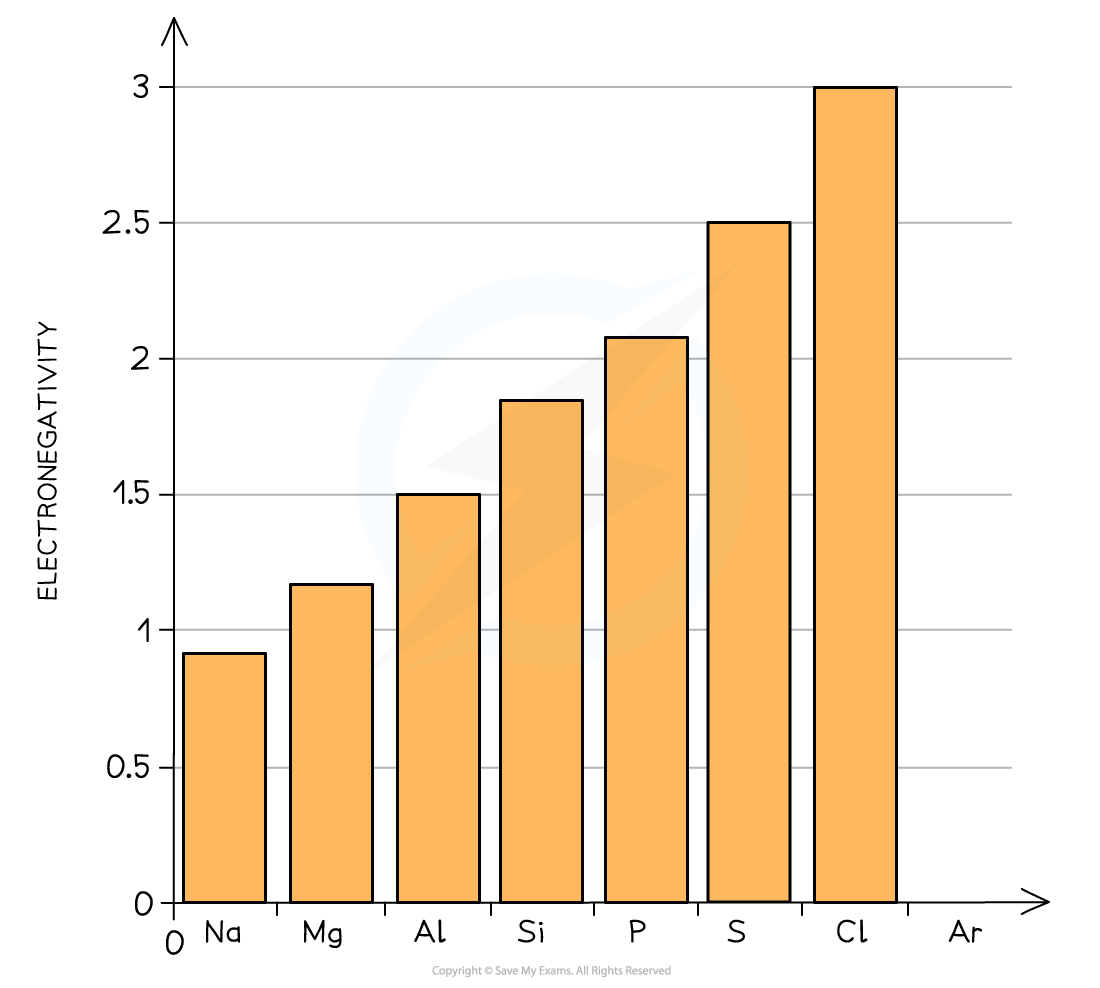
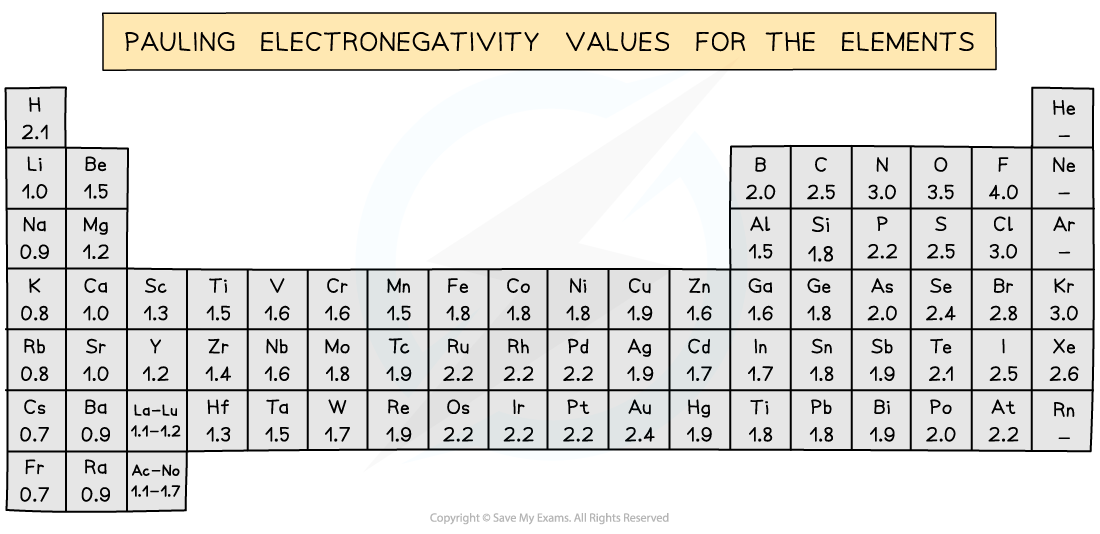
- Trend: Electronegativity increases across the period (from
: 0.9 to : 3.0). - Explanation: The increasing nuclear charge (with constant shielding) exerts a stronger pull on bonding electrons.
- Note on Bonding: The difference in electronegativity between elements dictates bonding. High difference = Ionic (e.g.,
). Small/Zero difference = Covalent (e.g., , ).
🧊 Phase 2: Bonding & Physical Properties of the Elements
Syllabus Content: 9.1 & 9.2
Explain the variation in melting point and electrical conductivity in terms of the structure and bonding of the elements. Suggest the types of chemical bonding present from observations of chemical and physical properties.
1. Structure & Bonding Across the Period
- Metals (
): Giant metallic lattices (positive metal ions in a ‘sea’ of delocalised electrons). 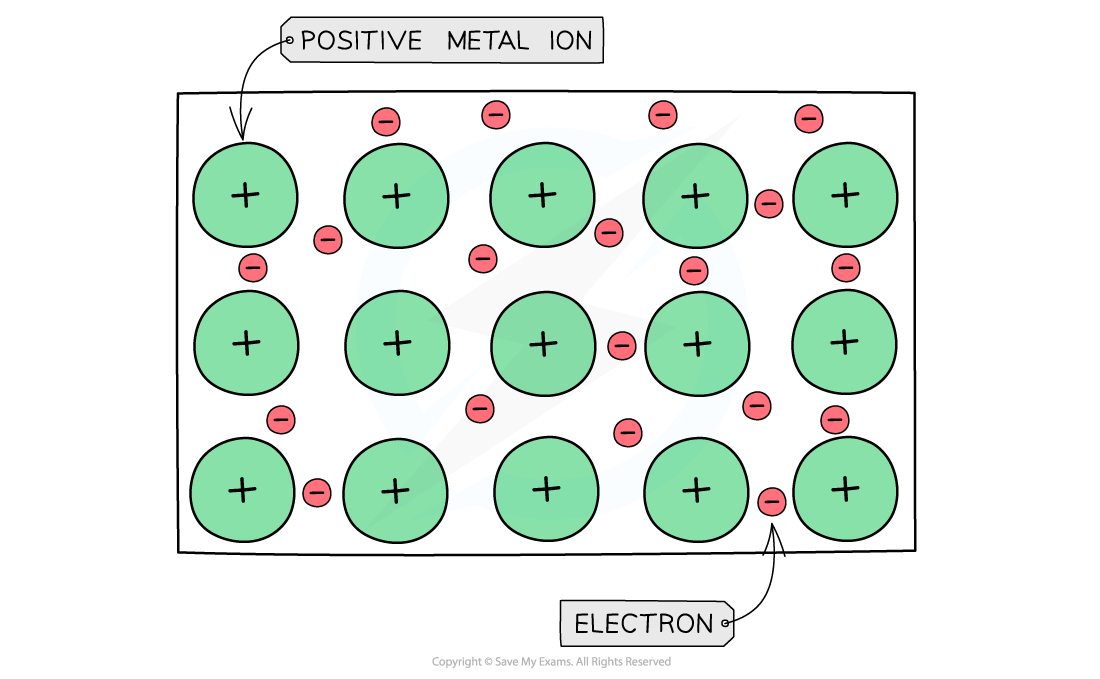
- Metalloid (
): Giant molecular (macromolecular) covalent lattice. 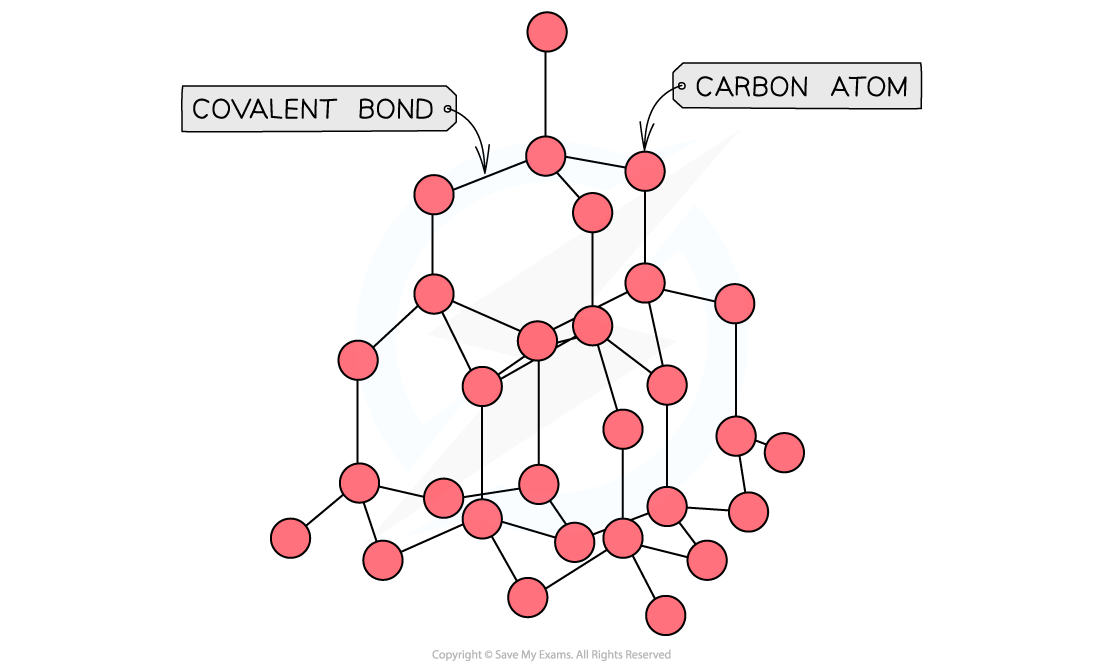
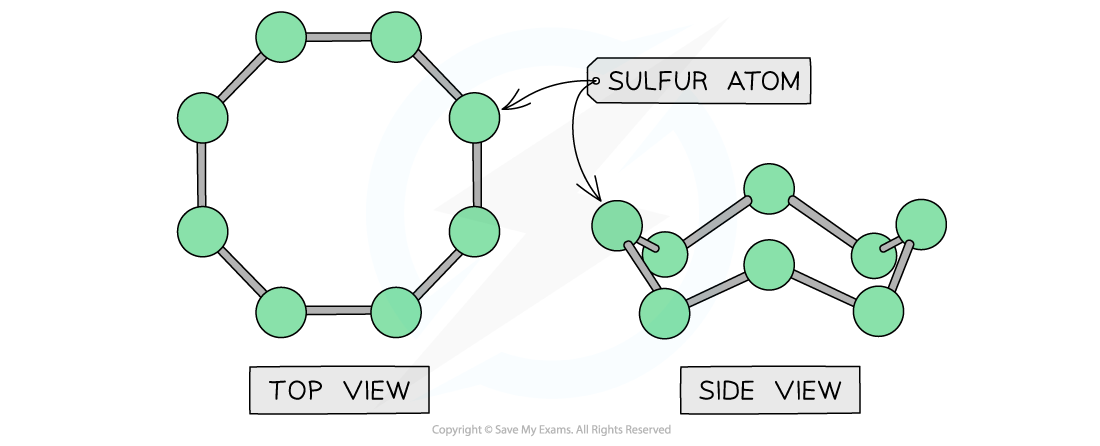
- Non-metals (
): Simple molecular structures with strong intramolecular covalent bonds but weak intermolecular forces. 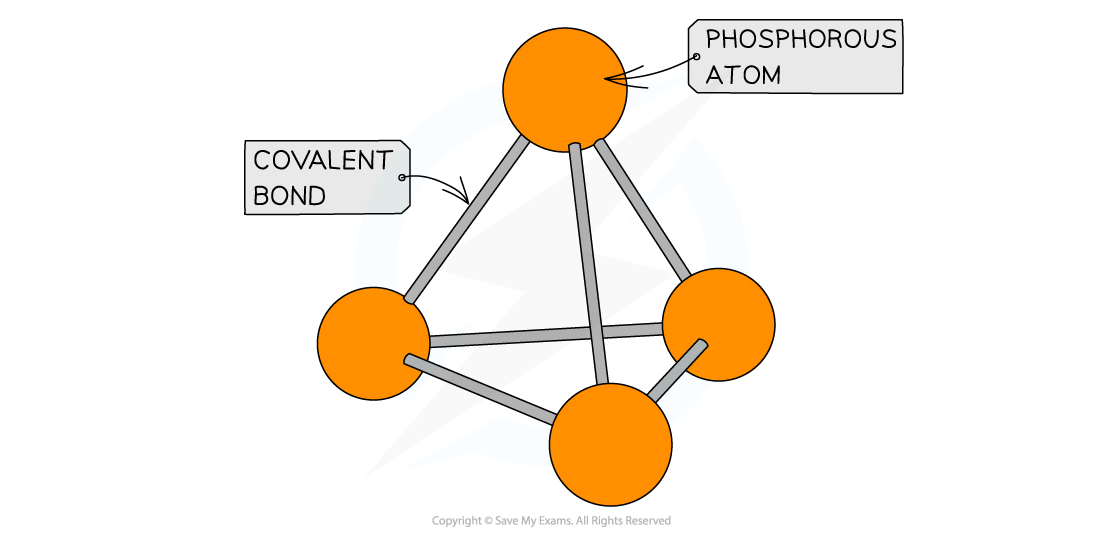
2. Melting Point Trend
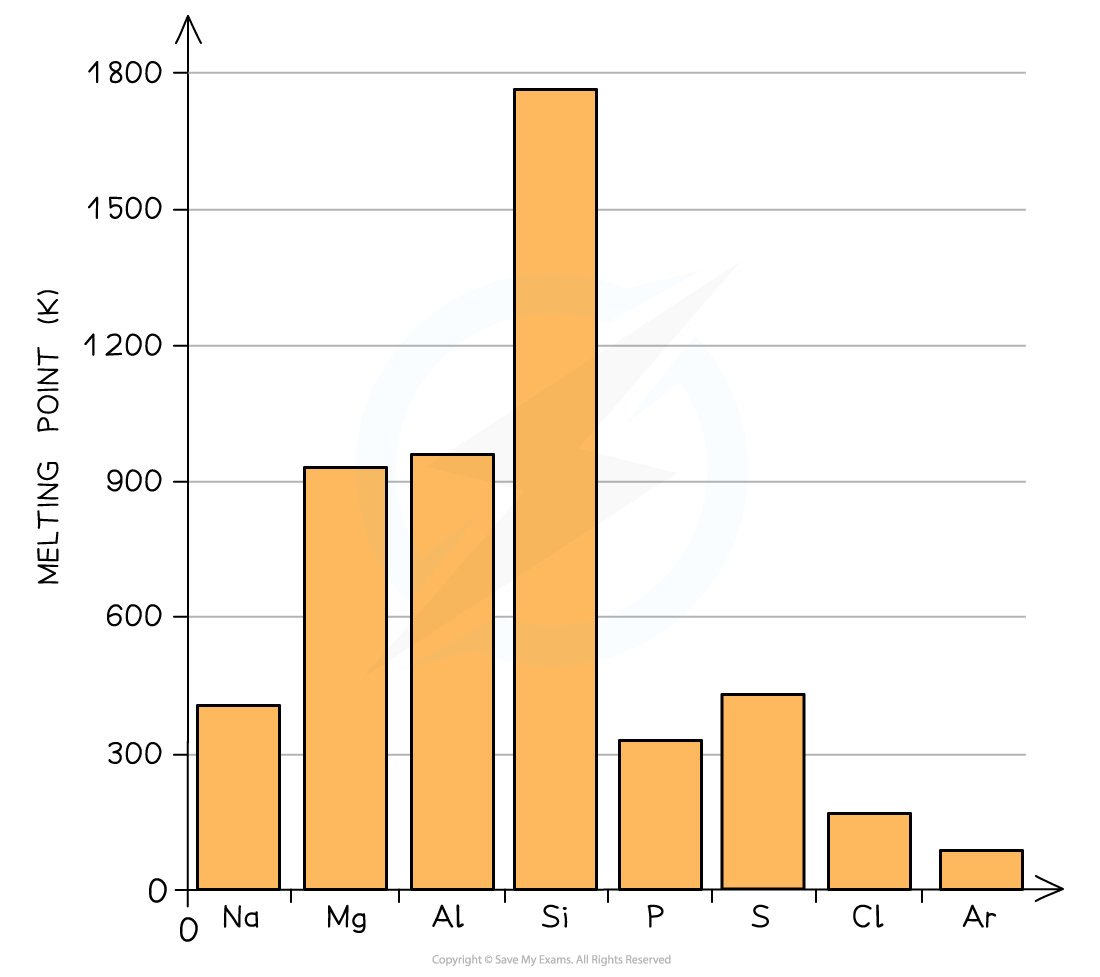
(Increases): Melting points increase. donates 3 electrons to the delocalised ‘sea’ per atom, compared to ‘s 2 and ‘s 1. Furthermore, the ion has a higher charge density. This creates stronger electrostatic forces between the cations and the delocalised electrons (stronger metallic bonding). (Peak): Silicon has the highest melting point (1683 K). It forms a giant covalent lattice (like diamond). Breaking the structure requires breaking very strong, extensive covalent bonds between atoms, which requires massive thermal energy. (Sharp Drop & Low): These form simple molecules ( ). To melt them, you only need to overcome weak instantaneous dipole-induced dipole forces (London dispersion forces) between molecules, not covalent bonds. -
Examiner Tip:
vs
Sulfur has a higher melting point than phosphorus. Sulfur exists as
molecules, which are larger and have more electrons than molecules. This creates stronger instantaneous dipole-induced dipole forces that require more energy to break. -
3. Electrical Conductivity
(Increases): is the best conductor because it contributes the highest number of mobile delocalised electrons (charge carriers) to the metallic lattice. (Plummet): Silicon is a metalloid/semiconductor. It has no delocalised electrons capable of moving freely at room temperature because all valence electrons are locked in covalent bonds. (Zero): They are perfect insulators. They consist of neutral simple molecules with no mobile ions or delocalised electrons.
💥 Phase 3: Chemical Reactions of the Elements
Syllabus Content: 9.2
Describe, and write equations for, the reactions of the elements with oxygen (to give
, , , , ), chlorine (to give , , , , ) and water (Na and Mg only).
1. Reactions with Oxygen (Heating)
: Reacts vigorously. Bright yellow flame. Forms a white solid: : Reacts vigorously. Bright white flame. Forms a white solid: : Reacts fast (if powdered). Bright white flame. Forms a white powder: : Reacts slowly (needs strong heat). Bright white sparkles. Forms a white powder: : Reacts vigorously. Yellow or white flame. Forms white clouds: : Reacts gently. Blue flame. Forms a toxic gas:
2. Reactions with Chlorine (Heating)
All form chlorides. The reactions become generally less vigorous going right.
(Vigorous) (Vigorous) (Vigorous) (Note: forms the dimer!) (Slow) (Slow, with excess chlorine)
3. Reactions with Water (
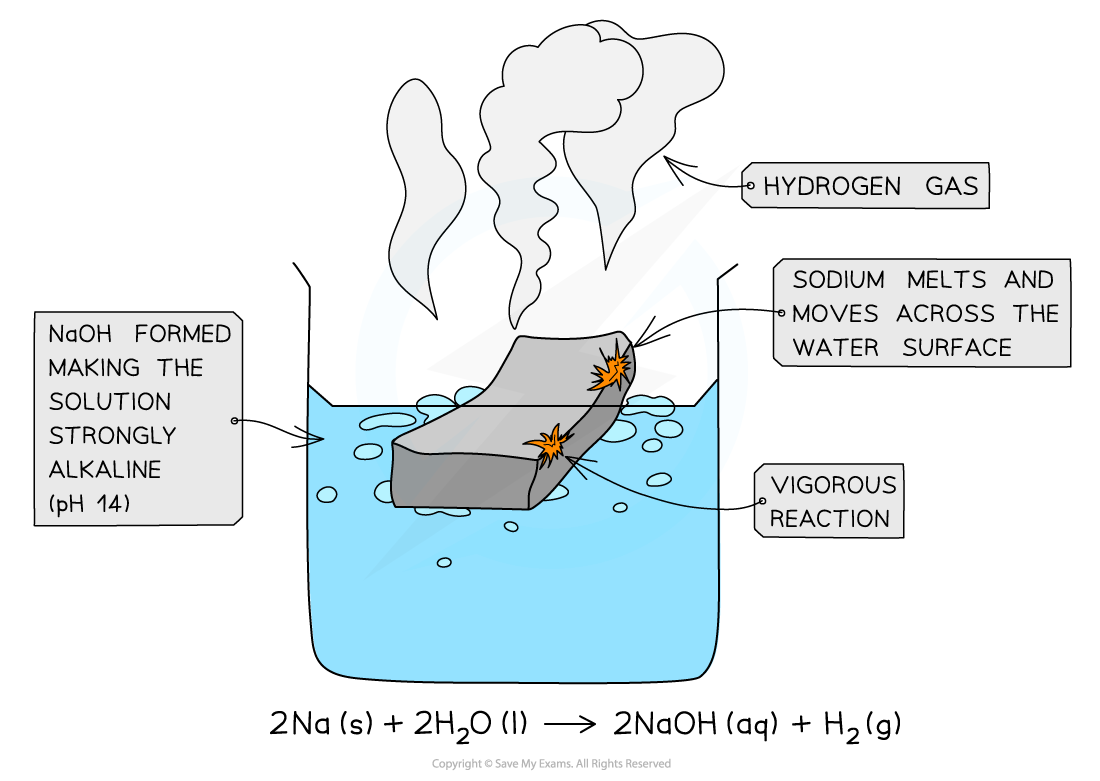
- Sodium (
): Reacts vigorously with cold water. It melts into a ball, moves across the surface, fizzes (hydrogen gas), and leaves a strongly alkaline solution (pH 14). - Magnesium (
): - With cold water: Reacts extremely slowly. Forms a weakly alkaline solution (pH 11) because
is only slightly soluble. - With steam: Reacts vigorously when heated to form magnesium oxide and hydrogen.
- With cold water: Reacts extremely slowly. Forms a weakly alkaline solution (pH 11) because
🧪 Phase 4: The Compounds (Oxides & Chlorides)
Syllabus Content: 9.2
State and explain the variation in oxidation number. Describe, explain, and write equations for the acid/base behaviour of the oxides and the hydroxides. Describe, explain, and write equations for the reactions of the chlorides with water, including the likely pHs of the solutions obtained.
1. Oxidation States
The max oxidation state equals the group number (number of valence electrons involved in bonding).
(+1), (+2), (+3), (+4), (+5), (+6).
2. Period 3 Oxides
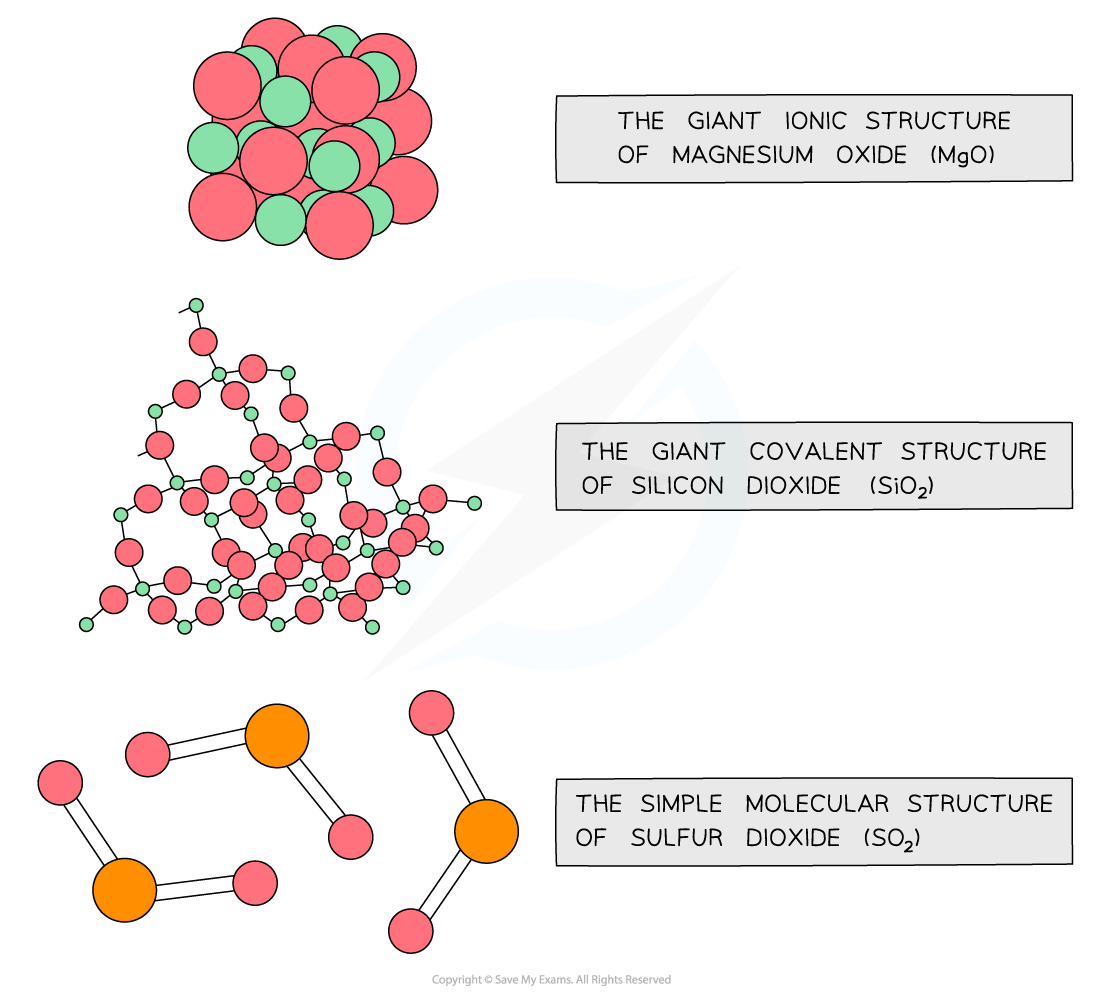
| Oxide | ||||||
|---|---|---|---|---|---|---|
| Bonding | Ionic | Ionic | Ionic (covalent character) | Covalent | Covalent | Covalent |
| Structure | Giant Ionic | Giant Ionic | Giant Ionic | Giant Covalent | Simple Molec. | Simple Molec. |
| Nature | Basic | Basic | Amphoteric | Acidic | Acidic | Acidic |
Reactions with Water:
: Dissolves to form a strongly alkaline solution (pH 12-14). : Sparingly soluble, forms a weakly alkaline solution (pH 8-10). & : Insoluble (no reaction). : Vigorous reaction, forms a weakly acidic solution (pH 3-4). & : Forms strongly acidic solutions (pH 1-2). (Sulfurous acid) (Sulfuric acid)
Acid/Base Behaviour & Equations:
- Basic (
): React with acids. E.g., - Amphoteric (
): Reacts with BOTH acids and bases. - With Acid:
- With hot, conc. Base:
- With Acid:
- Acidic (
): React with bases. (Note: forms Sodium Silicate)
3. Period 3 Chlorides
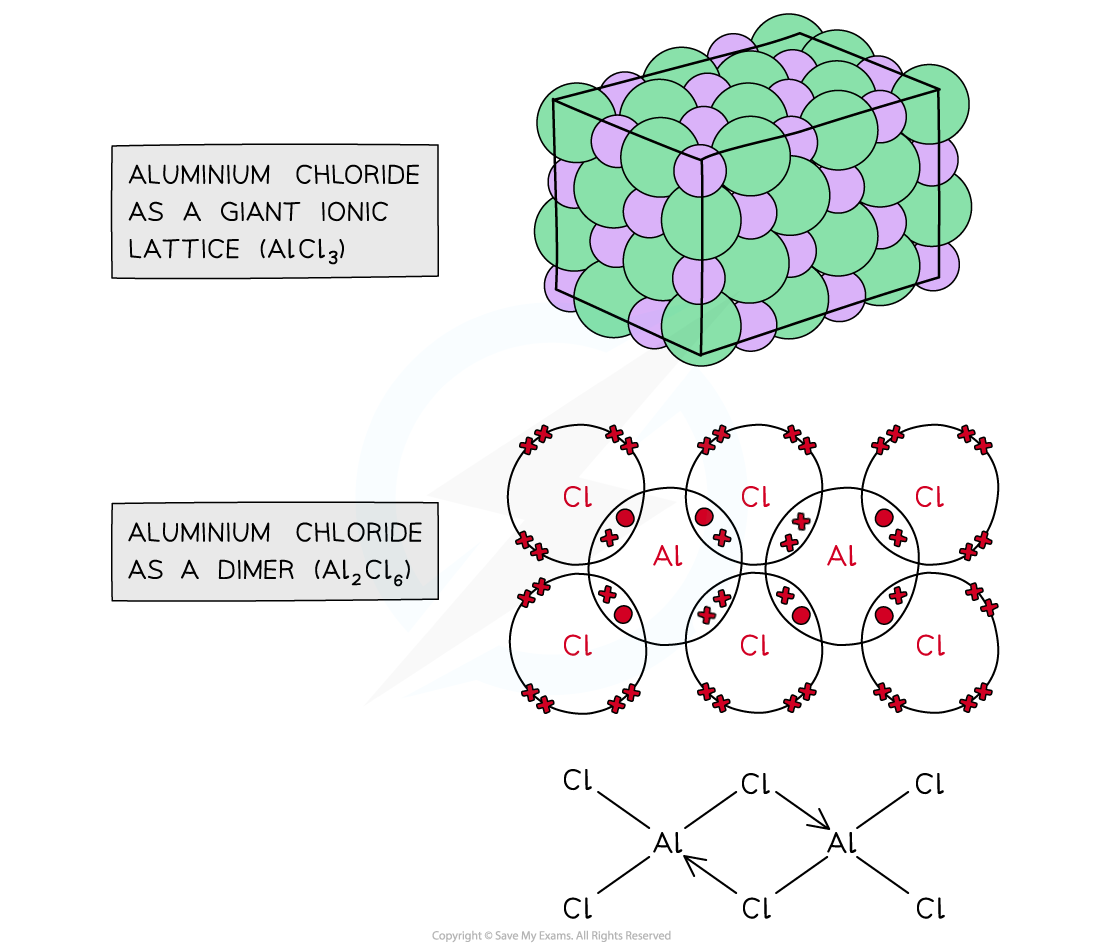
| Chloride | |||||
|---|---|---|---|---|---|
| Bonding | Ionic | Ionic | Covalent Dimer | Covalent | Covalent |
| Structure | Giant Ionic | Giant Ionic | Simple Molecular | Simple Molec. | Simple Molec. |
Reactions with Water (Dissolving vs Hydrolysis):
& : Simply dissolve (hydration of ions). No chemical bonds are broken within the water molecules. Solutions are pH 7.0 and 6.5 respectively. ( ): The highly charged ion becomes hydrated . Because it has a very high charge density, it strongly polarises the attached water molecules, forcing them to release an ion into the solution. 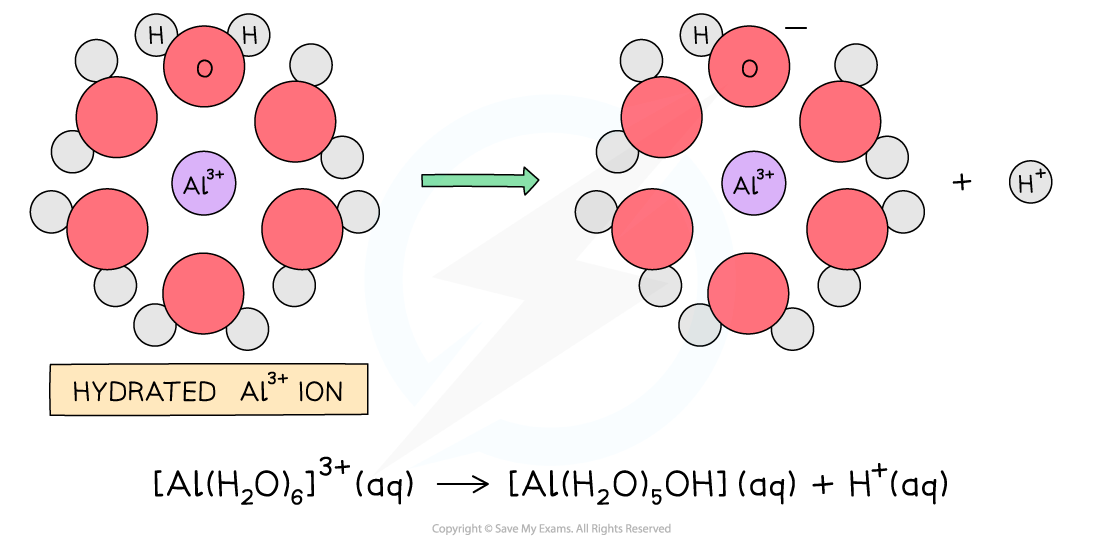
- Produces an acidic solution (pH ~3.0) and gives off steamy white fumes of
.
: Rapid hydrolysis. Produces a white precipitate of and steamy white fumes of gas. Highly acidic solution (pH 2.0). : Rapid hydrolysis. Produces steamy white fumes of gas. Highly acidic solution (pH 2.0).
🏆 Phase 5: Synthesis & Application (Exam Mode)
Syllabus Content: 9.3
Predict the characteristic properties of an element in a given group by using knowledge of chemical periodicity. Deduce the nature, possible position in the Periodic Table and identity of unknown elements from given information about physical and chemical properties.
1. Predicting Periodicity
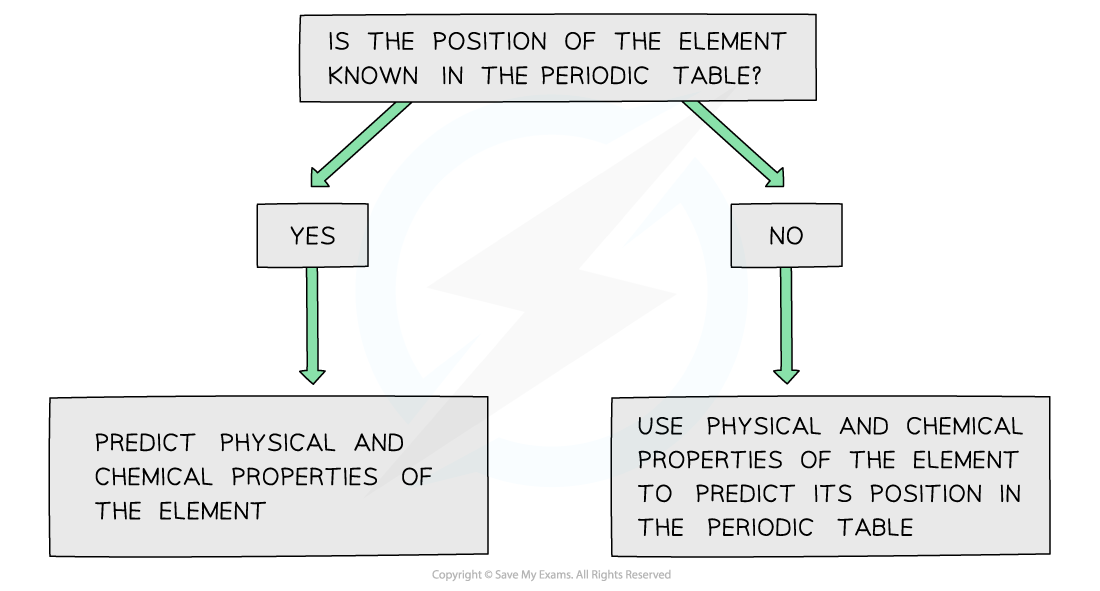 If an exam asks about an element outside Period 3, look at its group:
- Selenium (
, Group 16): Will behave exactly like Sulfur. It will exist as a simple molecule, have a low MP, be an electrical insulator, and form acidic simple molecular oxides ( ) that dissolve in water to form acids. - Germanium (
, Group 14): Will behave like Silicon. It will form a giant covalent lattice, have a very high melting point, and act as a metalloid/semiconductor.
2. Examiner Gems & Mark Scheme Secrets
The
Hydrolysis Secret Why does
hydrolyse rapidly in water, but does not react at all? Mark scheme answer: Silicon has available, energetically accessible empty d-orbitals. The lone pair of electrons on the oxygen atom of a water molecule can form a dative covalent bond with these empty d-orbitals to initiate hydrolysis. Carbon (Period 2) does not have d-orbitals.
Dissolving vs Hydrolysis Terminology
When
is added to water, it dissolves. When is added to water, it hydrolyses. Using the word “dissolves” for or will lose you marks.
Aluminium's Protective Oxide Layer
Aluminium is highly reactive, but often appears unreactive in lab experiments. Why? Mark scheme answer: Aluminium reacts rapidly with oxygen in the air to form a tough, continuous, unreactive surface layer of
which prevents further reaction (corrosion).
The Aluminium Chloride Dimer
At room temperature,
is an ionic lattice. But when heated, it sublimes at 180°C to form a gas consisting of covalent dimers ( ). The two molecules are held together by coordinate (dative) bonds where a Chlorine atom donates a lone pair into Aluminium’s empty orbital.
State Symbols for Fumes
If a question says “steamy white fumes are observed”, your equation MUST include
with the (g)state symbol. If you write, you lose the state mark, because is a liquid solution, not a fume!
Alternative Formulas (
& ) Don’t panic if they give you
instead of , or (a cherry-red liquid). Apply the exact same rules! They are simple molecular non-metal compounds. They will have low melting points, poor conductivity, and will hydrolyse in water to form acidic solutions.
Real-world Applications
- Indigestion Remedies:
and are used to treat indigestion because they are basic enough to neutralise excess stomach acid, but sparingly soluble enough that they don’t produce strongly alkaline solutions that would harm the body. - Bauxite Purification: The amphoteric nature of
is used to extract it from bauxite ore. Reacting the ore with hot dissolves the as , leaving basic rocky impurities behind as solids to be filtered out.