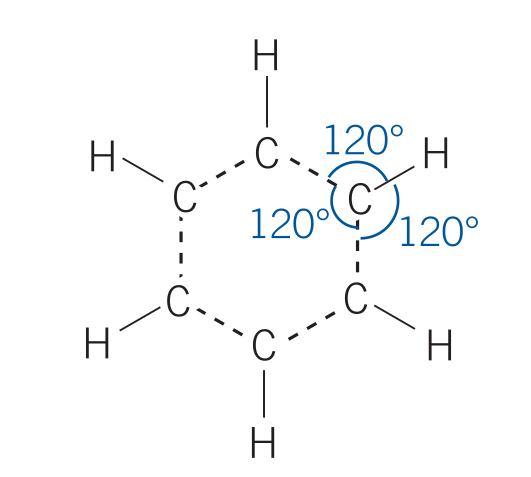
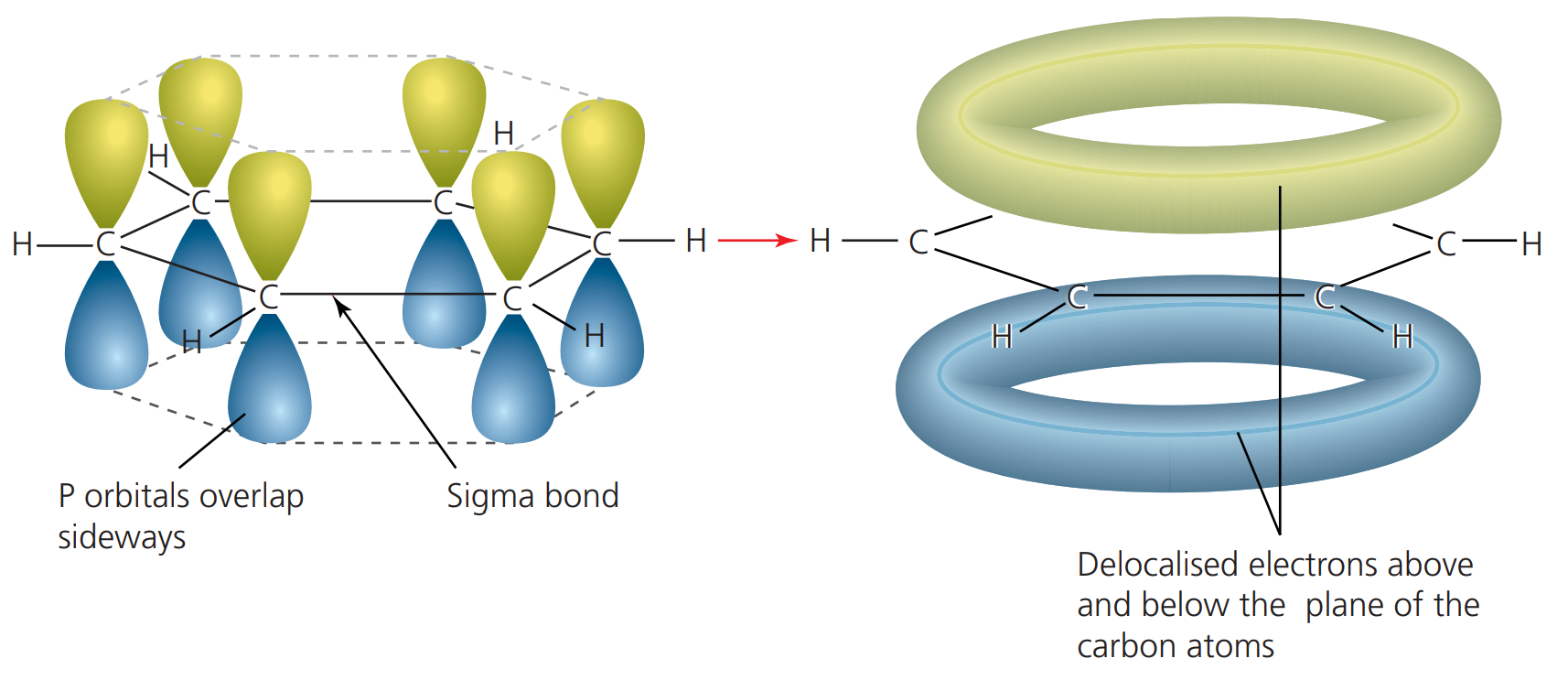
In a benzene ring, each carbon atom bonds to only three other atoms (two neighbouring carbons and one hydrogen) via 3 sigma bonds.
Hybridisation
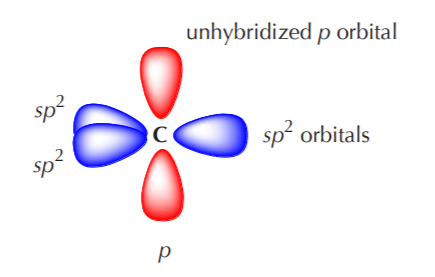
The carbon atom mixes one -orbital and two -orbitals to create three identical hybrid orbitals.
One -orbital remains unhybridised
Bonding
The 3 orbitals allow each carbon to form 3 sigma bonds (two neighbouring carbons and one hydrogen).
VSEPR
To keep the negatively charged electron clouds as far apart as possible, these orbitals arrange themselves in a flat, trigonal planar shape.
The angle between these bonds is exactly °
2. Delocalised -Electron Cloud
Merging of -orbitals
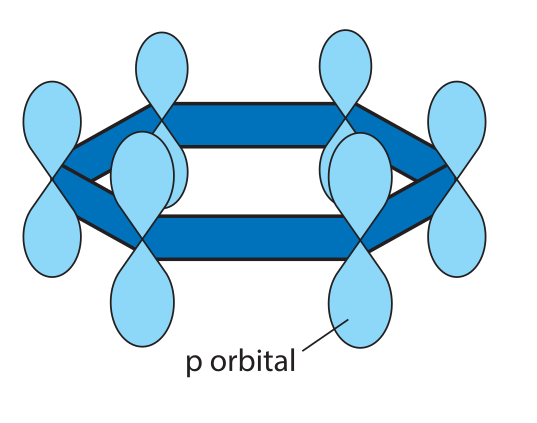
The six unhybridised -orbitals, one on each carbon atom, are all parallel to each other and perpendicular to the plane of the carbon ring.
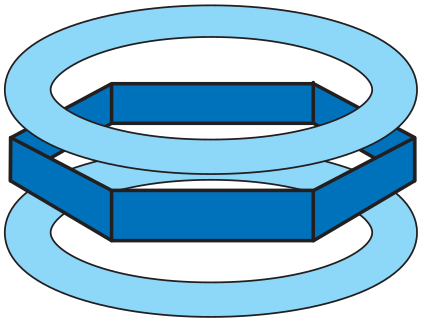
Each -orbital overlaps sideways equally with adjacent -orbitals, forming a delocalised, six-centre molecular -bond above and below the plane of the carbon ring.
3. The Resulting Structure
Combining the carbon ring and delocalised electron clouds gives benzene’s signature structure
Key Features of Benzene's Structure
Each carbon atom has a bond angle of 120° with adjacent atoms and a trigonal planar shape.
All carbon-carbon bonds are equal in length and strength.
All carbon-hydrogen bonds are equal in length and strength.