Structure
What functional group is present in carbonyl compounds?
- The carbonyl group:
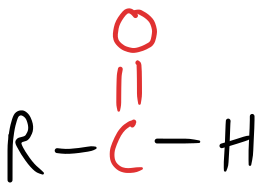
Where is the carbonyl group situated in an aldehyde?
- At the end of the carbon chain
- General formula:
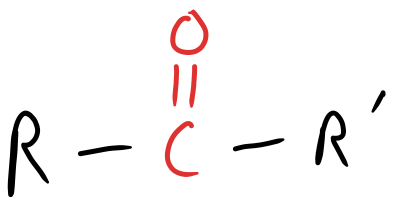
Where is the carbonyl group situated in a ketone?
- Within the carbon chain
- General formula
What is the hybridisation of the carbon in the carbonyl group (
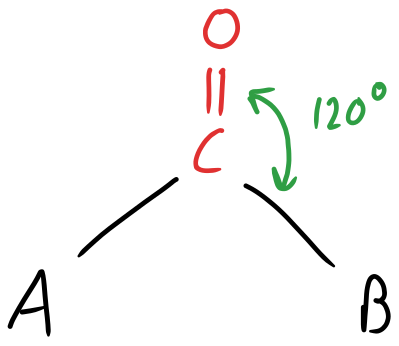
What is the shape around the carbonyl group?
- Trigonal planar
- Bond angle 120 degrees
Physical Properties
Explain why the carbonyl group is polar.
- Oxygen is much more electronegative than carbon.
- Oxygen draws electron density towards itself.
- This creates a permanent dipole
State and explain how the boiling points of carbonyl compounds compare to alkanes of similar relative molecular mass.
- Higher boiling point.
- The carbonyl group is polar, leading to permanent dipole-permanent dipole attraction.
State and explain how the boiling points of carbonyl compounds compare to alcohols of similar relative molecular masses.
- Boiling point is lower.
- Alcohols have hydrogen bonding (hydrogen bonded to NOF:
). - Carbonyl compounds do not contain hydrogen bonded to NOF so no hydrogen bonding.
State and explain the solubility of small carbon chain carbonyl compounds in water.
- Highly soluble.
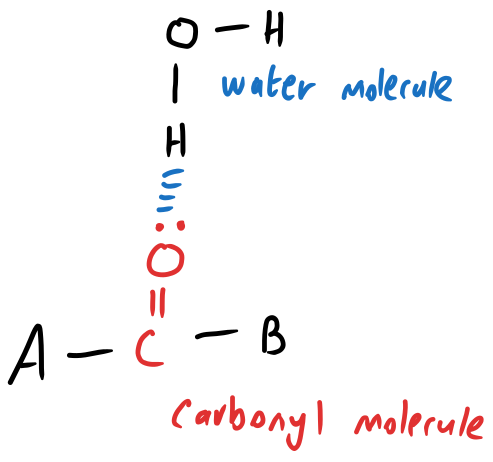
- The lone pair on the oxygen atom of the carbonyl group can form hydrogen bonds with water molecules.
State and explain the solubility of long carbon chain carbonyl compounds in water.
- Insoluble
- For long chains, the non-polar part becomes the dominant part of the molecule.
- The long carbon chain cannot form hydrogen bonds with water molecules.
- This is because the London dispersion forces formed by the non-polar part is too weak to disrupt hydrogen bonding in water
State and explain whether carbonyl compounds can form hydrogen bonds.
- They cannot form hydrogen bonds with themselves due to absence of hydrogen bonded to NOF.
- They can form hydrogen bonds with water molecules as they contain a lone pair of electrons on a NOF atom.
- The lone pair accepts hydrogen bonding from the
in water.
Preparation of carbonyl compounds
State by which method aldehydes and ketones are produced.
- Oxidation of alcohols.
State the reagent used in the preparation of aldehydes and ketones.
- Acidified potassium dichromate (VI) (
) OR - Acidified potassium manganate (VII) (
)
Give the observations for the preparation of aldehydes and ketones.
- If acidified potassium dichromate used:
- Colour change from orange to green
- If acidified potassium manganate (VII) used:
- Colour change from purple to colourless
Preparation of Aldehydes
State the reagents and conditions for the preparation of aldehydes.
- Reagent: Primary alcohol + Acidified
- Conditions: Heat and distil off the product immediately as it forms.
Give the equation for the preparation of aldehyde.
Explain the conditions for the preparation of aldehyde.
- Heat:
- To provide activation energy for alcohol and oxidising agent molecules to have effective collisions for reaction to take place.
- To vaporise the aldehyde formed for distillation.
- Distil off: To prevent further oxidation of aldehyde to carboxylic acid.
Preparation of ketones
State the reagent and conditions for the preparation of ketones.
- Reagent: Secondary alcohol + Acidified
- Conditions: Heat under reflux.
Give the equation for the preparation of ketones.
Explain the conditions for the preparation of ketones.
- Heat:
- To provide activation energy for alcohol and oxidising agent molecules to have effective collisions for reaction to take place.
- Reflux:
- Ketones cannot be easily further oxidised
- Reflux ensures that the reaction goes to completion without risking over-oxidation.
Reduction Reactions
State by which method aldehydes and ketones can be converted into alcohols.
- Reduction
State the reducing agents that can be used to reduce aldehydes and ketones to alcohols.
- Aqueous
. in dry ether.
State the conditions for reduction of aldehydes and ketones using
- Aqueous
- Room temperature
is a weak reducing agent.
State the conditions for reduction of aldehydes and ketone using
in dry ether. - Room temperature
is a strong reducing agent that reacts violently with water.
State the product when aldehydes are reduced.
- Primary alcohols
State the equation for the reduction of aldehydes
State the product when ketones are reduced.
- Secondary alcohols.
State the equation for the reduction of ketones.
Nucleophilic Addition of HCN
Explain why the carbonyl group is susceptible to attack by nucleophiles (4).
- The
bond is polar as oxygen is much more electronegative than carbon. - The shared electrons in the double bond is drawn towards the oxygen atom.
- This leaves a partial positive charge on the carbon atom (
) - This makes the carbon atom open to attack by nucleophiles.
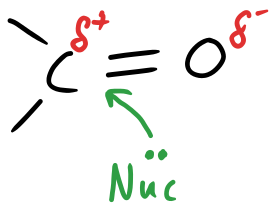
State the product of the nucleophilic addition of HCN to carbonyl compounds.
- Hydroxynitriles
State the reagents and conditions for nucleophilic addition of HCN to carbonyl compounds.
- Reagent:
and - Conditions: Heat under reflux
Why is
- To produce
in situ as it is highly toxic. is a weak acid and partially dissociates. - The
dissociates completely to provide a high concentration of ions to act as nucleophile. provides the ion for the second step of the mechanism.
Give the equation for the in situ formation of
Give the equation for the formation of nucleophile for the nucleophilic addition of
Draw the mechanism for nucleophilic attack of ethanal by 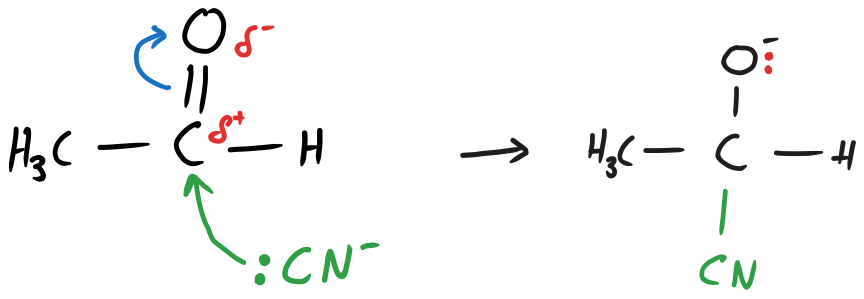
Draw the mechanism for protonation of intermediate/regeneration of catalyst for nucleophilic addition of 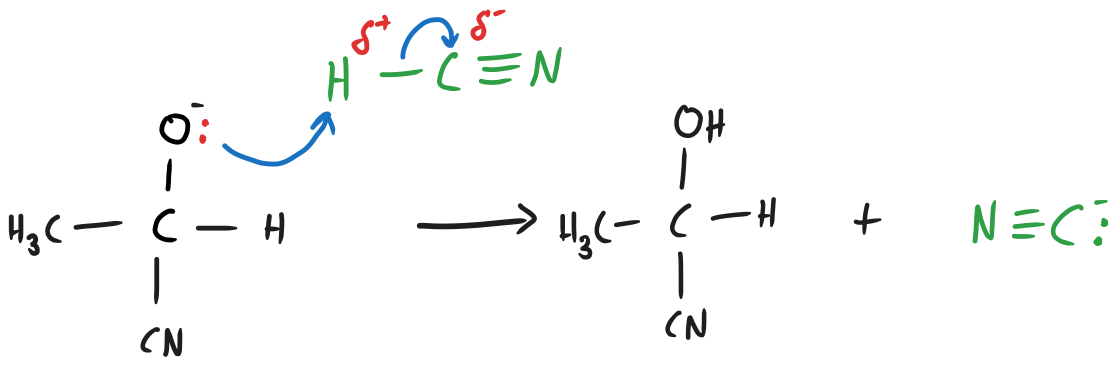
Draw the full mechanism for nucleophilic addition of 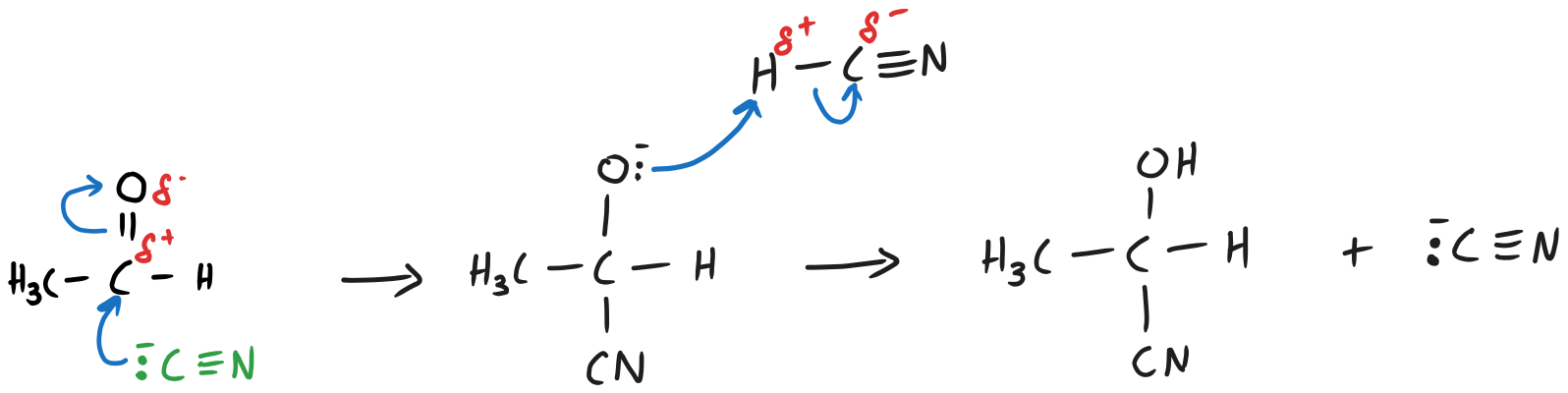
State the rate determining step of the nucleophilic addition of
- Nucleophilic attack of
on carbonyl carbon(step 1)
Explain why nucleophilic attack of
- The most energy is needed to break the pi bond of the
and to overcome electron-electron repulsion as the negative ion approaches the molecule.
Racemic mixture of products
Explain why the resulting mixture is racemic
- The carbonyl carbon is
hybridised, so the molecule is trigonal planar around the carbonyl group. - The nucleophile can attack from either side with equal probability.
- The result is a racemic mixture, which contains equimolar amounts of both enantiomers.
- The resulting mixture has no effect on plane-polarised light.
Testing and Identification
Test for carbonyl
What test is used to test for presence of carbonyl group (
- Reagent: 2,4-DNPH
- Observation: Deep orange precipitate
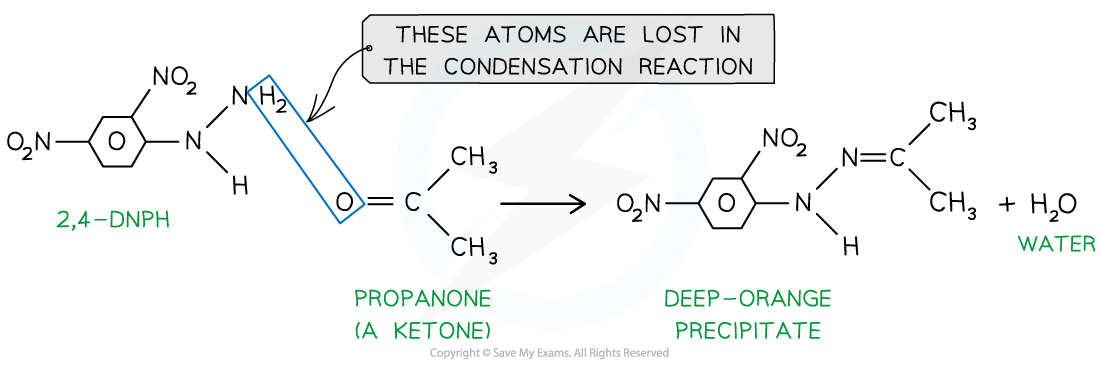
What type of reaction occurs when 2,4-DNPH is used to test for presence of carbonyl group?
- Condensation
What is the observation when 2,4-DNPH is added to a solution of a carbonyl compound?
- Deep orange precipitate
Give the steps to determine the identity of the specific aldehyde or ketone from a positive 2,4-DNPH test (4). (NIS)
- Filter the orange precipitate
- Recrystalise to purify the derivative (the filtered of solid is dissolved and recrystalised)
- Determine its melting point
- Compare the melting point to a data booklet of known values to identify the original aldehyde or ketone.
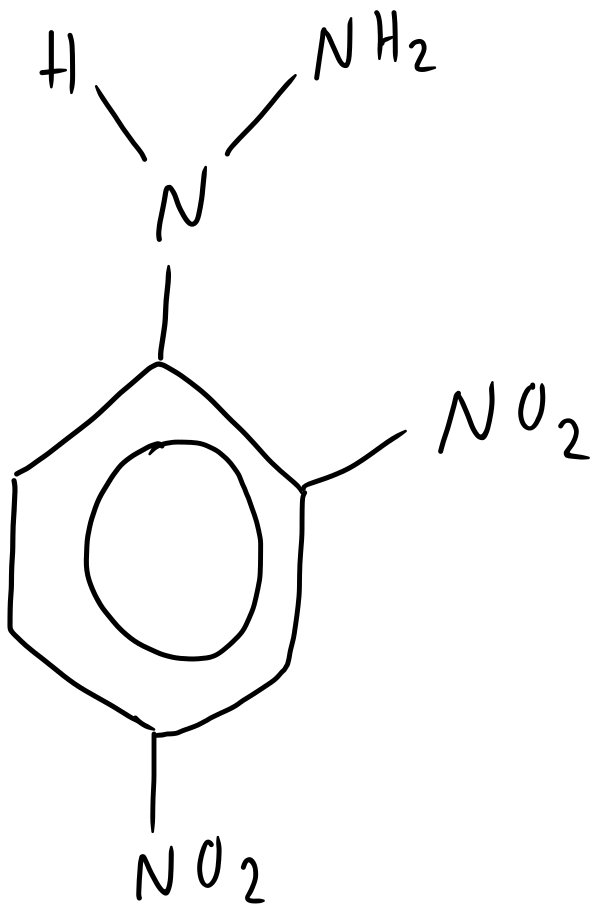
Draw the structure of 2,4-DNPH
Draw the reaction of 2,4-DNPH with Propanone.
Distinguishing Aldehydes from ketones
What tests can be used to distinguish between aldehydes and ketones?
- Tollens’ Reagent
- Fehling’s Solution
What principle allows Tollens’ Reagent or Fehling’s Solution to distinguish between aldehydes and ketones?
- Aldehydes can be easily oxidised while ketones cannot.
- Mild oxidising agents are used to tell them apart.
What types of reagents are Tollens’ Reagent and Fehling’s Solution?
- Mild oxidising agents
Explain why a carboxylic acid is not obtained from the oxidation of an aldehyde by Fehling’s Solution or Tollens’ Reagent
- The aldehyde is oxidised to a carboxylic acid
- However, since the conditions are alkaline, the carboxylic acid is neutralised to form the carboxylate ion
How could you obtain ethanoic acid from the mixture after reacting ethanal with Fehling’s Solution?
- Acidify the mixture using dilute strong acid
- (Neutralise the
) and reacts with carboxylate ion
State whether Tollens’ Reagent and Fehling’s solution give positive results with carboxylic acids.
- No
- WITH THE EXCEPTION OF methanoic acid (
)
State why methanoic gives a positive result with Tollens’ Reagent and Fehling’s solution
- Methanoic acid contains an aldehyde group
- The aldehyde group is easily oxidised by Fehling’s solution of Tollens’ reagent.
Tollens’ Reagent
State the chemical name of Tollens’ Reagent.
- Ammoniacal Silver Nitrate
State the reagents used for Tollens’ Reagent
in aqueous ammonia.
State the ion present in Tollens’ Reagent.
State the conditions for using Tollens’ Reagent
- Warm in a water bath
State what is observed with Tollens’ Reagent when an aldehyde is present.
- A silver mirror is formed on the inside of the test tube.
State what is observed with Tollens’ Reagent when a ketone is present.
- No visible change
Explain why Tollens’ Reagent gives a positive result with aldehydes but not with ketones.
- Tollens’ reagent can oxidise aldehydes but not ketones.
Give the ionic equation including state symbols for the reaction of Tollens’ Reagent with an aldehyde
State what species is oxidised when Tollens’ Reagent is used.
- Aldehyde (
) is oxidised into carboxylate ion ( ) - Loss of hydrogen
State what species is reduced when Tollens’ Reagent is used.
is reduced to - Decrease in oxidation state/gain in electron
Explain the principle by which Tollens’ reagent is able to identify aldehydes
- Tollens’ reagent is a mild oxidising agent
- It can oxidise aldehydes
- The
ions in the Tollens’ reagent are reduced to solid which gives a silver mirror
Fehling’s Solution
State the reagent use for Fehling’s Solution
- Alkaline solution containing
State the colour of Fehling’s solution
- Blue (due to
)
State the conditions for using Fehling’s Solution
- Warm in a water bath
State what is observed with Fehling’s Solution when an aldehyde is present.
- Blue solution turns into a brick red precipitate.
State what is observed with Fehling’s Solution when a ketone is present.
- Solution remains blue/No visible change
Explain why Fehling’s Solution gives a positive result with aldehydes but not with ketones.
- Fehling’s Solution can oxidise aldehydes but not ketones.
Give the ionic equation including state symbols for reaction of Fehling’s Solution with an aldehyde
State the species responsible for the blue colour of Fehling’s solution
State the species responsible for the brick red precipitate when an aldehyde is added to Fehling’s Solution
State the species that is oxidised when an aldehyde is added to Fehling’s Solution
- Aldehyde (
) is oxidised to carboxylate ion ( ) - Loss of hydrogen
State the species that is reduced when an aldehyde is added to Fehling’s Solution
is reduced to - Decrease in oxidation number/gain of electron
Explain the principle behind which Fehling’s solution can identify aldehydes
- Fehling’s solution is a mild oxidising agent
- It can oxidise aldehydes
ions in the Fehling’s solution are reduced to forming a brick red precipitate of
Iodoform test
What group does the iodoform test for?
- Methyl carbonyl
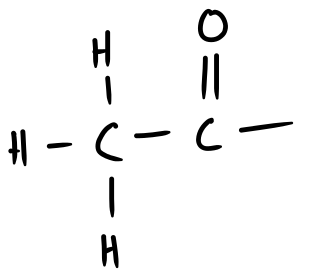
What groups give a positive result with iodoform test?
(Methyl carbonyl)
Explain why iodoform test gives a positive result with
- The oxidising nature of the reagents oxidise the secondary alcohol into a methyl carbonyl
- The methyl carbonyl gives a positive result with iodoform test.
State the reagents used for iodoform test
- Alkaline aqueous Iodine (
+ or )
State the conditions for iodoform test
- Warm
State the observation for iodoform test if methyl carbonyl present
- Yellow precipitate
State the identity of the yellow precipitate obtained in iodoform test
- Tri-iodomethane/
State the overall ionic equation including state symbol for iodoform test
State with what aldehydes iodoform test gives a positive result
- Ethanal only
- Ethanal is the only aldehyde containing
group
State with what ketones iodoform test gives a positive result
- All methyl ketones
- Examples: propanone, butanone, pentan-2-one, hexan-2-one, etc.
- All methyl ketones contain the
group
State whether iodoform test gives a positive result with carboxylic acids
- No