Structure and Bonding
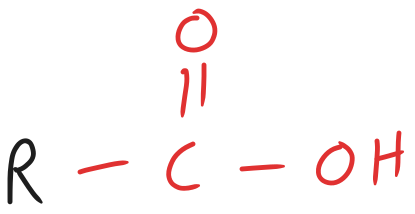
What is the functional group of carboxylic acids?
(Carboxyl Group)
How do the boiling points of carboxylic acids compare to alkanes and alcohols of similar relative molecular mass?
- Carboxylic acids have higher boiling points
Explain why carboxylic acids have higher boiling points than alkanes of similar relative molecular mass.
- Alkane molecules only have London dispersion forces between them (as they are non polar)
- Carboxylic acid molecules have hydrogen bonding between them (as they contain hydrogen bonded to a highly electronegative atom)
- Hydrogen bonding is stronger than London dispersion forces (therefore more energy is needed to cause boiling)
Explain why carboxylic acids have higher boiling points than alcohols of similar relative molecular mass.
- Dimerisation
- Both alcohols and carboxylic acids contain hydrogen bonding.
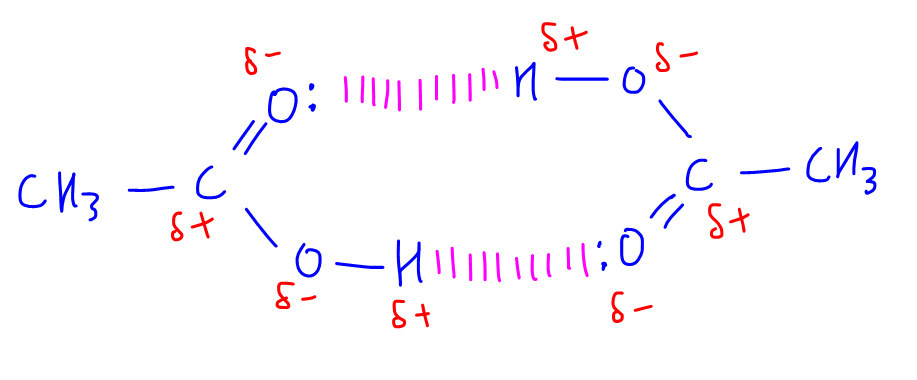
- Carboxylic acids form dimers via two hydrogen bonds between a pair of molecules.
- Alcohols only form one hydrogen bond between a pair of molecules.
- More energy is needed to break the more extensive hydrogen bonding in the acid
What phenomenon causes a carboxylic acid to appear to have double its expected relative molecular mass (
) in the gas phase or a non-polar solvent?
- Carboxylic acids can form dimers via two hydrogen bonds between a pair of molecules.
Why can carboxylic acids form two hydrogen bonds between a pair of molecules?
- The hydrogen atom in the -OH group is highly electron deficient as it is attached to a highly electronegative atom.
- The lone pair of electrons on the carbonyl oxygen of one molecule is electrostatically attracted to the
hydrogen of the second molecule. - Because the -OH and C=O groups are on the same carbon atom, two molecules align face-to-face
- Allowing the interaction to happen twice simultaneously.
Describe and explain the trend in solubility of carboxylic acids in water as the hydrocarbon chain lengthens.
- Trend
- As the hydrocarbon chain length increases, the solubility of carboxylic acids in water decreases.
- Explain
- The carboxyl group is polar and forms hydrogen bonds with water molecules.
- The hydrocarbon chain is non-polar and hydrophobic
- As chain length increases, the non-polar hydrophobic portion becomes the dominant part of the molecule.
- The larger non-polar chain disrupts the existing hydrogen bonds between water molecules but cannot form hydrogen bonds itself;
- Making it energetically unfavourable for the molecule to dissolve.