Chemistry of transition elements
Define a transition element
A d-block element that forms one or more stable ions with incomplete 3d orbitals.
Define the term degenerate
Orbitals are at the same energy.
State the full electronic configuration of
State the colour of the aqueous solution of
Deep blue
State the colour of the aqueous solution of
Yellow
Explain why aqueous complex ions of transition elements are usually coloured.
- The presence of ligands cause the d-subshell to split into two sets of non-degenerate d-orbitals.
- An electron is promoted from a lower-energy d-orbital to a higher-energy d-orbital
- By absorbing a photon having a specific frequency of visible light
- This frequency is missing from the transmitted light therefore the complementary colour is seen.
Todo
Explanation of tetrahedral/octahedral ligand approach leading to different d splitting based on shape of orbitals
State the type of reaction when an excess of
is added to a solution of Ligand Exchange
Give the equation for the reaction when an excess of
is added to a solution of
Suggest how dianion P can form three dative covalent bonds.
Dianion P Two oxygen and one nitrogen can donate three lone pairs of electrons to the central metal ion.
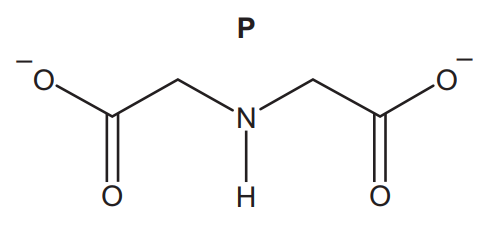
Deduce the formula and charge of the complex ion Q based on the following information
Dianion P,
can act as a tridentate ligand. 2 moles of P react with 1 mole of aqueous cobalt(III) ions, to form 1 mole of complex ion Q
Define the stability constant of a complex
Equilibrium constant for the formation of the complex ion in a solvent from its constituent ions or molecules.
State the relationship between stability of a complex ion and its stability constant
The higher the stability constant the more stable the complex ion.